Why Canadian stocks fell while Wall Street rode AI volatility higher

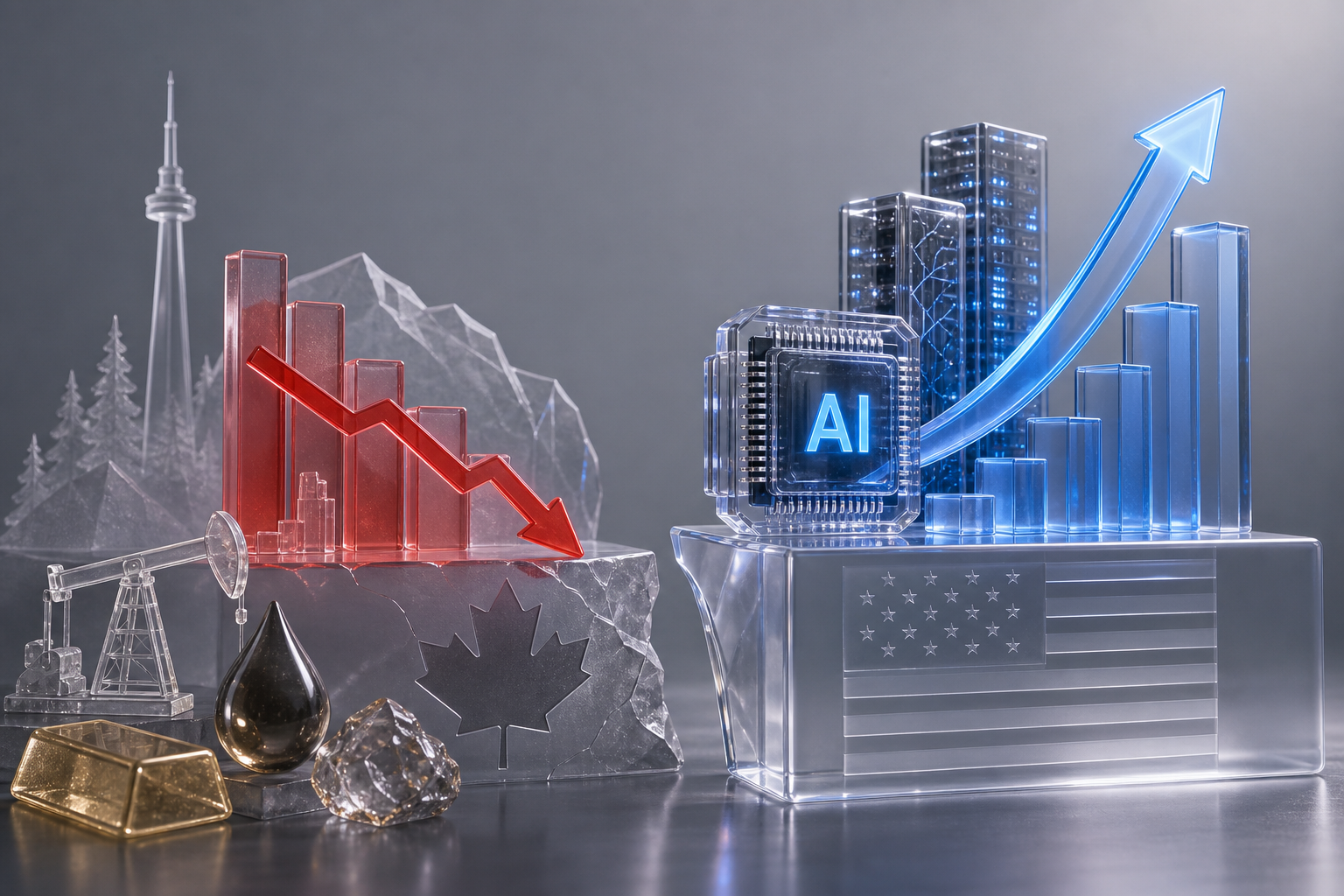
The S&P/TSX Composite finished lower Thursday while U.S. markets closed mixed, continuing a pattern that has defined 2026: Canadian equities lag while Wall Street wrestles with AI-fueled swings.
The divergence is structural, not accidental. The TSX fell 0.4%, weighed by declines in energy and materials, sectors that make up roughly 35% of the index. West Texas Intermediate crude slipped below $72 USD per barrel, dragging Canadian producers with it. Gold dropped 1.2%, pulling miners down. These are tangible assets tied to global demand cycles, and when demand softens, the TSX has limited places to hide.
Wall Street's story ran differently. The S&P 500 edged up 0.1%. The Nasdaq-100 gained 0.3%, propped up by late buying in chipmakers after a morning selloff. Neither move was dramatic, but the intraday whipsaw was. Nvidia dropped 3% at the open, reversed to positive by noon, then gave half of it back by close. This is the routine now: sharp swings on earnings whispers, analyst downgrades, or vague statements about AI infrastructure returns. The volatility doesn't come from uncertainty about whether AI matters. It comes from disagreement about what $200 billion in annual capital expenditures by the Magnificent Seven should produce in revenue within 18 months.
The resource anchor problem
The TSX's dependency on commodities has always been a double-edged position. When oil trades in the $70 to $85 range, as it has through most of 2026, Canadian energy stocks generate cash flow but little excitement. The sector isn't collapsing, several producers report margins wide enough to fund dividends and buybacks. But margin stability doesn't move stock prices when growth investors are chasing semiconductor companies posting 40% revenue growth.
Materials face a similar bind. Copper demand from the energy transition story remains intact over the long term, but short-term pricing reflects Chinese construction slowdowns and inventory builds. A zinc miner with strong fundamentals still trades at 9 times earnings while a software company with comparable margins trades at 30. The multiple gap reflects where capital sees upside, and right now, upside lives in Silicon Valley's server farms, not Northern Ontario's pits.
The Bank of Canada's rate cuts, three reductions since June 2024, bringing the overnight rate to 3.75%, were meant to stimulate. They've provided relief to mortgage holders renewing at lower rates than feared, but they haven't ignited business investment in the commodity-heavy sectors that dominate the TSX. Lower rates help indebted consumers. They don't raise the price of oil.
Why the valuation gap persists
U.S. traders expect the Federal Reserve to raise rates by year-end 2026, a reversal from the easing path it began in 2024. That expectation reflects inflation that has cooled to 2.2% in Canada but remains stickier in the U.S., particularly in services. A hawkish Fed supports the U.S. dollar, which makes Canadian exports cheaper but also signals that American economic growth, and corporate earnings, can sustain tighter money.
The result is a valuation environment where the S&P 500 trades at 21 times forward earnings while the TSX sits near 14. The discount isn't irrational. The Canadian index lacks the high-margin, scalable businesses that justify premium multiples. Financials make up 20% of the TSX, and while the Big Six banks are profitable, they're rate-sensitive and tied to a housing market that remains expensive relative to incomes. Utilities and consumer staples add defensive ballast but no momentum.
The AI volatility that defines U.S. trading doesn't show up in Toronto because the companies driving it don't list here. Canada has no equivalent to Nvidia, no hyperscalers spending tens of billions on data centers. What it has are the materials that build those data centers, and materials are priced as inputs, not growth stories.
So the TSX absorbs commodity weakness while Wall Street rides AI's roller coaster higher.