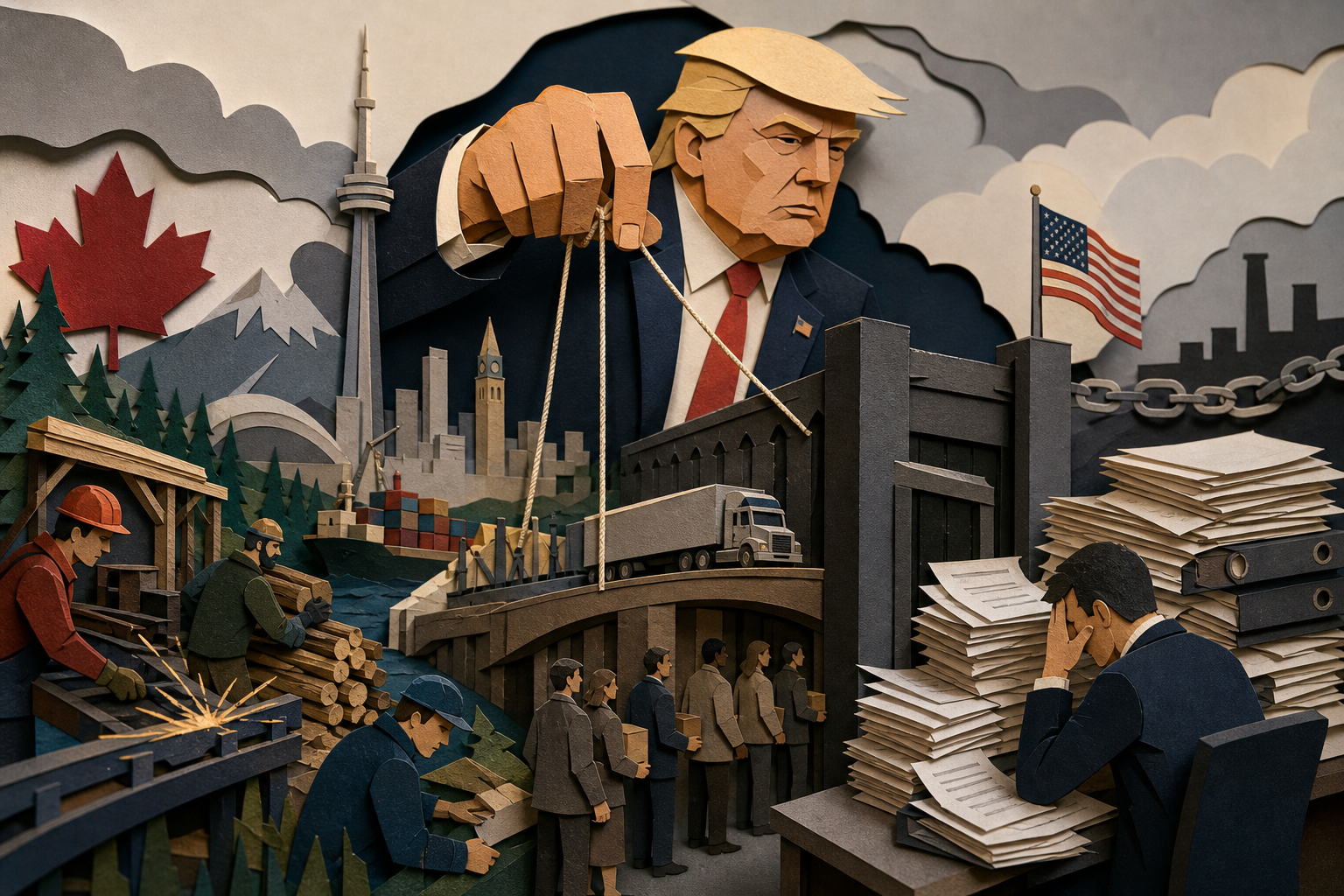
Trump's tariff threats are noise, not policy. Canada should treat them accordingly.


Trump's tariff threats are noise, not policy. Canada should treat them accordingly.
In eighteen months, Donald Trump and his advisors have floated at least seven different tariff structures, universal baselines, reciprocal rates, sector-specific levies, and a rotating cast of exemptions that appear and vanish depending on the news cycle. None of them stayed on the table long enough to become an actual trade bill.
That's not policy development. It's brand management.
The pattern matters more than the percentages. A 10% universal tariff gets announced. State governors from Michigan and Ohio, who export more to Ontario than to California, immediately call their senators. Industry groups representing the automotive and energy sectors point out that 50% of U.S.-Canada trade is intermediate goods moving through integrated supply chains. The White House backs off, reframes the threat as a "negotiating position," and moves to the next headline. Two weeks later, the cycle repeats with different numbers.
Canada's temptation, every time, is to treat each threat as a crisis requiring an immediate diplomatic scramble. That impulse is what the tactic depends on. The moment Ottawa dispatches a cabinet minister to Washington, cancels other priorities, and puts together a concessions package, the threat has already worked, whether or not a single tariff gets implemented.
Why the integrated supply chain still matters
The arithmetic hasn't changed since 2018. The U.S. imports roughly 60% of its crude oil from Canada, a figure that has held steady even as domestic shale production expanded. Thirty-two U.S. states count Canada as their top export destination. Aluminum smelters in Quebec feed rolling mills in Indiana. Lumber from British Columbia frames houses in Texas. A tariff on Canadian steel raises costs for a General Motors plant in Michigan before it touches a single Canadian balance sheet.
That interdependence is Ottawa's strongest card, and it doesn't require playing it loudly. U.S. manufacturing lobbies understand the cost structure better than any Canadian talking points could explain. When Section 232 tariffs on steel and aluminum were floated in 2018, the successful Canadian counter-strategy wasn't a charm offensive, it was a quiet demonstration that the North American defense industrial base runs on integrated production. The exemptions followed.
The same logic applies to any broad tariff scheme proposed today. A 10% universal tariff, if actually implemented, would reduce Canadian GDP by an estimated 1-1.5% in the short term, according to C.D. Howe Institute modeling. It would also function as a direct tax on U.S. consumers and manufacturers, a fact that becomes unavoidable the moment construction costs spike or auto assembly lines start idling.
The 2026 CUSMA review isn't the crisis it looks like
The Canada-U.S.-Mexico Agreement is up for its formal joint review in 2026, which creates a natural window for the current rhetorical barrage. The timing is deliberate. But the review mechanism itself was designed to allow exactly this: a re-examination period where all three countries confirm in writing whether they wish to extend the agreement for another sixteen years.
That structure was never going to be quiet. The fact that it coincides with a U.S. election cycle makes it louder, but not fundamentally different. Canada doesn't need to preemptively renegotiate terms that aren't yet on the table.
What Canada should do, instead, is exactly what it did during the original NAFTA renegotiation: stay boring. Maintain the technical working groups. Keep the cross-border trade data updated. Let the U.S. governors and industry groups who benefit from the current structure do the domestic lobbying. A government that reacts to every social-media-driven tariff threat with emergency measures is validating the tactic.
A government that treats noise as noise, and waits for an actual policy proposal before responding, forces the other side to either put something formal on the table or move on.
The next twelve months will produce more tariff headlines. The correct response to most of them is a shrug.