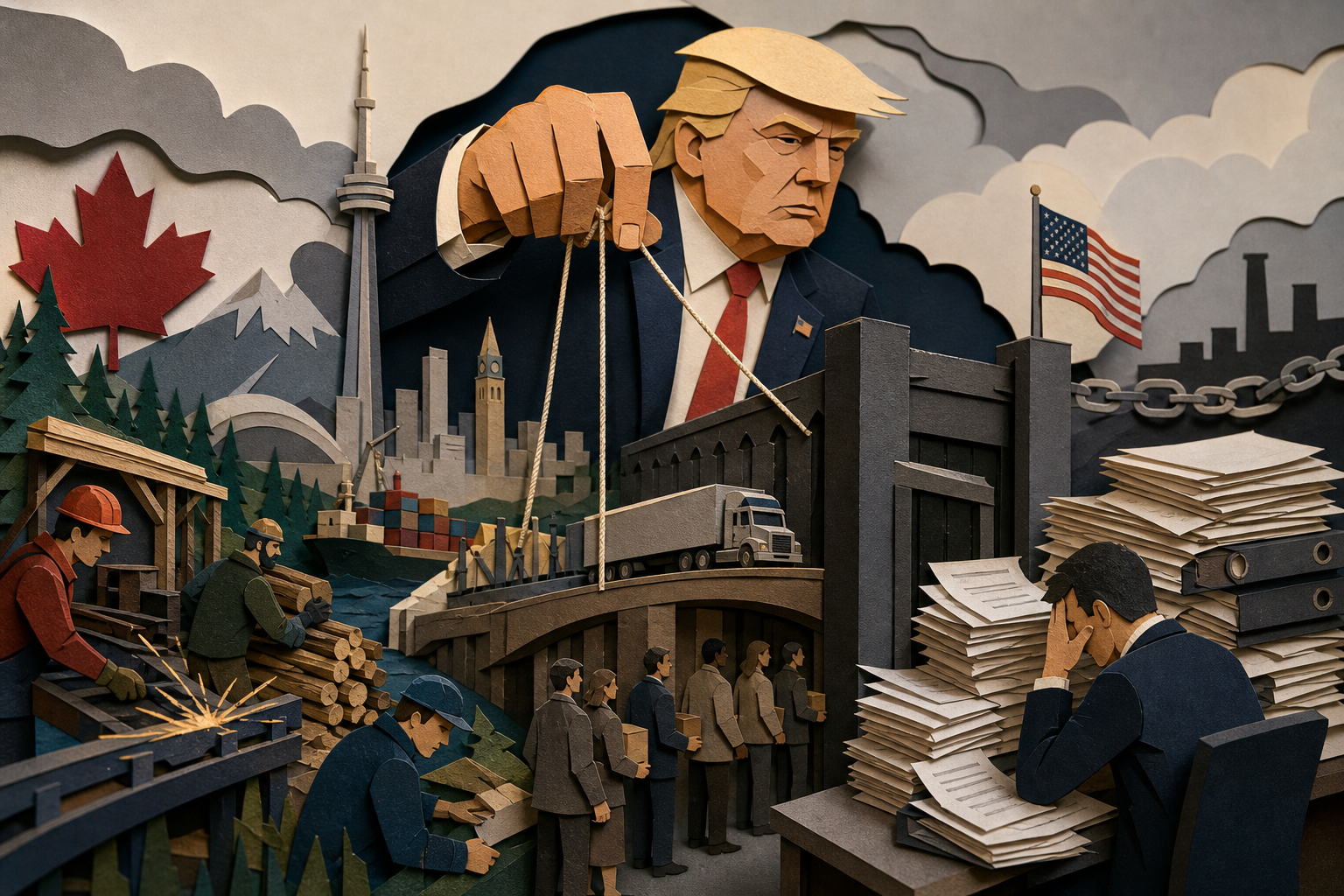
When GDP Flatlines and Fast Food Rethinks Labour: What Three Unrelated Stories Reveal About Canada's Economic Moment


The Productivity Stall No One Will Call a Recession
Statistics Canada announced in May that real GDP growth in the first quarter of 2026 was essentially zero. Not negative. Not positive. Just flat. The headline number avoids the technical definition of a recession, which requires two consecutive quarters of contraction. But the headline number is doing a lot of work to obscure what's actually happening: GDP per capita has now fallen for seven straight quarters. The economy isn't shrinking. It's just being divided among more people, which means each person's slice is getting thinner.
This isn't a temporary blip. Canada added roughly 1.2 million people between mid-2023 and mid-2025, most of it through immigration and temporary residents. Population growth of that speed requires the economy to grow just to stand still on a per-capita basis. It didn't. The result is what you'd expect: sticker shock on groceries, stagnant wages in real terms, and a housing crisis that refuses to break even as construction starts to pick up. The "lost decade" narrative economists used to threaten is no longer theoretical. It's the present tense.
Why Tim Hortons Suddenly Cares About Optics
In the same week GDP flatlined, Restaurant Brands International told its Tim Hortons franchisees to significantly reduce their reliance on the Temporary Foreign Worker program. The federal government tightened the rules in late 2024, dropping the cap on low-wage TFWs from 20% to 10% of a business's workforce. RBI's directive wasn't driven by a sudden surplus of domestic labour. It was driven by the fact that the TFW program has become a political liability.
Tim Hortons has always been more of a cultural barometer than a coffee chain. When the brand gets linked to wage suppression and housing demand in the same breath, corporate sees the risk. The move is about reputation management in a country where "temporary" foreign workers have quietly become permanent fixtures of the service economy, and where the voting public is starting to connect immigration volume to cost-of-living pressure.
The franchisees in rural Alberta or northern Ontario who can't find anyone willing to work the 5 a.m. shift for $17 an hour are going to absorb this however they can—reduced hours, more automation, or simply closing locations. RBI's concern is the brand, not the operator's staffing problem. That gap between corporate messaging and franchise-level reality is where the actual damage happens.
How a Shipyard Went From Ignored to Indispensable
Davie Shipbuilding was left out of the original National Shipbuilding Strategy when Ottawa divided the work between Irving and Seaspan in 2011. For years, Davie was the excluded bidder, watching contracts flow to two yards while it scrambled for smaller projects and foreign orders. Then the Arctic started melting faster than anyone expected, and Canada's need for icebreakers and polar-capable vessels became urgent.
Davie is now one of three primary pillars in the NSS. The company invested in capacity, acquired a Helsinki-based shipyard with specialized Arctic hull expertise, and lobbied relentlessly. Geopolitical necessity did the rest. As shipping routes open across the Northwest Passage and sovereignty concerns sharpen, the government needed a third domestic builder with credible cold-water capability. Davie had it.
The turnaround is clean, but the larger NSS remains a case study in cost overruns and multi-year delays. Davie's inclusion fixes a gap. It doesn't fix the underlying problem, which is that Canada still can't build ships on time or on budget at scale.
The Unifying Thread
Flat GDP. A coffee chain backing away from cheap labour. A shipyard clawing its way into a federal program. These don't feel connected, but they share a common structure: systems under stress making adjustments that buy time without solving the underlying problem.
The economy isn't collapsing. It's calcifying. Growth has stalled while the population surges, creating a zero-sum competition for wages, housing, and public services that didn't exist five years ago. Tim Hortons' TFW pullback is a tactical retreat from bad optics, not a signal that domestic labour markets have tightened. Davie's rise is real, but it's also a patch on a procurement system that remains deeply flawed.
None of this is a crisis in the traditional sense. It's worse. It's a long, slow adjustment to lower expectations.