War Inflation Just Pushed the US Saving Rate to a Four-Year Low

The consumer spending numbers for April 2026 don't show a collapse. They show something quieter and worse: a 0.1% monthly crawl, the kind of marginal gain that barely registers as movement. Real disposable income — what people actually have left after taxes and inflation — tightened enough that households dipped into savings to cover the basics. The personal saving rate dropped to 3.2%, the lowest reading since mid-2022.
This isn't consumers losing confidence. It's consumers running out of room.
The standard read on a low saving rate is that people feel secure enough to spend. That's the story when wages are climbing and discretionary purchases are up. It's not the story when energy costs are spiking because of supply shocks tied to conflicts in the Middle East and Eastern Europe, and households are burning through what's left of their cushion just to keep the lights on and the rent paid.
The gap that matters is between income growth and the price of non-negotiables. Nominal wages have grown, but they've lagged the cumulative three-year inflation surge badly enough that "real" wage growth — wages adjusted for what things actually cost — has been negative across most sectors. A household making $68,000 in 2023 that's now making $71,500 sounds like progress until you run the numbers on what rent, utilities, and groceries cost now versus then. The raise didn't cover the gap.
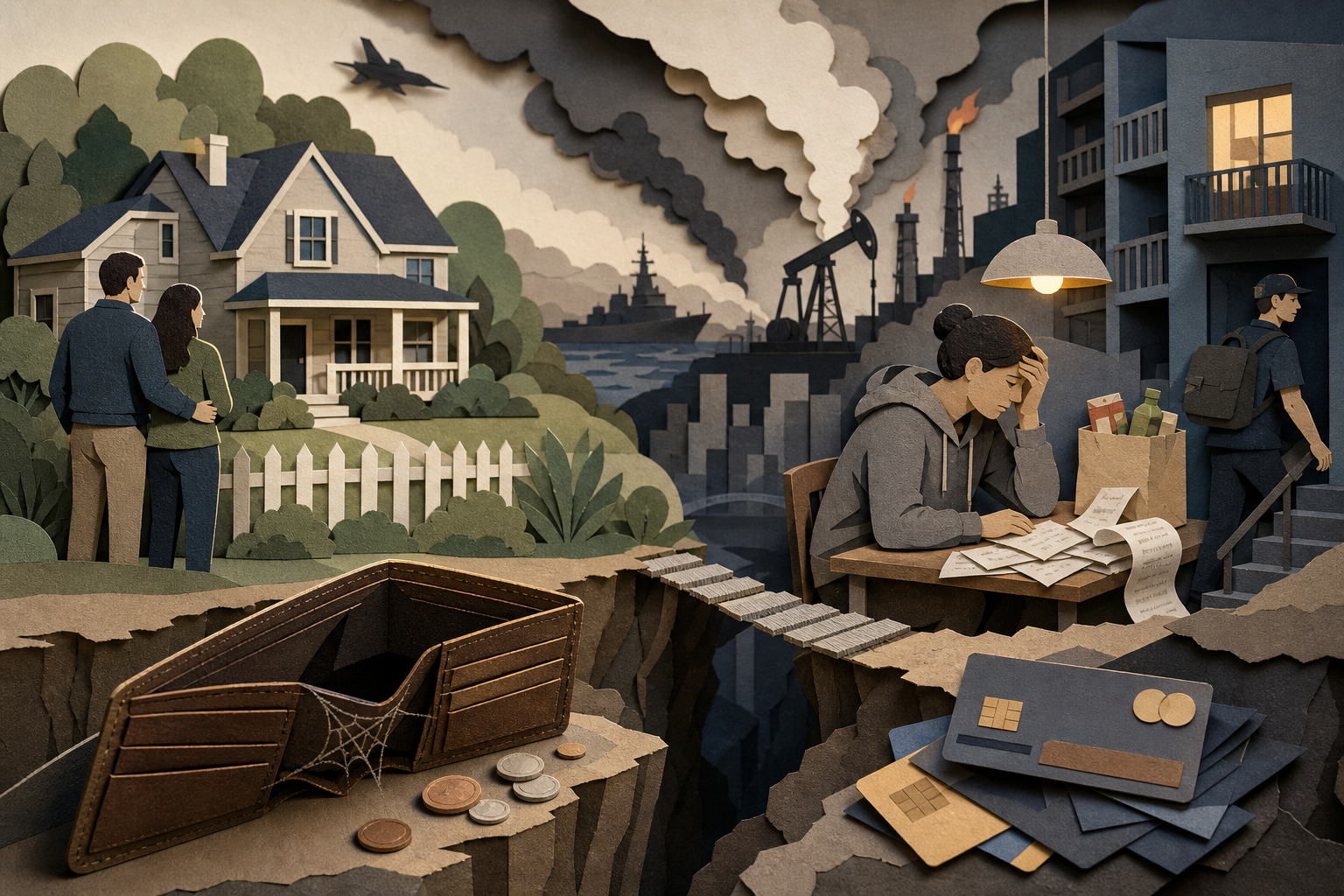
The credit bridge has a span limit
With savings scraped thin, the next move is predictable: credit. Household debt levels are climbing as consumers bridge the shortfall with plastic. Average credit card APRs are sitting above 21% in 2026, historic highs that turn a temporary fix into a compounding problem. The low saving rate isn't a sign of a healthy, confident consumer base. It's a leading indicator that the economy is one labor shock away from a hard stop.
The Federal Reserve is holding rates high to cool demand and bring inflation back toward the 2% target. Core CPI is running between 3.1% and 3.5% in recent prints, still well above where the Fed wants it. But the inflation that's sticky right now — energy, food — isn't demand-driven. It's supply-constrained, driven by geopolitical volatility that monetary policy can't touch. Raising rates cools the part of the economy that wasn't overheating and leaves the actual problem untouched.
This creates a split that aggregate data hides. Homeowners who locked in mortgages at 1.79% in 2021 are insulated. Renters and first-time buyers are bearing the full weight of both high prices and high rates. High-net-worth households, buoyed by a stock market that held up through 2025 and into 2026, are still spending on travel and luxury goods. That spending shows up in the top-line numbers and masks the financial strain hitting the bottom 60% of earners, who don't have portfolios and are watching their checking accounts flatten every month.
The unemployment rate remains low, which is the floor keeping this from tipping into a full contraction. But labor market resilience and consumer financial health are not the same thing. You can have a job and still be one surprise car repair away from a minimum payment you can't make.
The price levels are the psychological break. Even if inflation slows, the sticker shock has reset expectations. A gallon of milk that cost $3.20 in 2021 and $4.80 now doesn't feel like "inflation is cooling" when it stays at $4.70. The anchoring effect works against the recovery narrative, and CPI data that shows deceleration doesn't undo that.
War-driven inflation was supposed to be transitory, in the sense that the conflicts would eventually resolve or supply chains would reroute. What wasn't priced in was how long "eventually" could stretch, or how thin household buffers were after two years of post-pandemic spending exhaustion. The saving rate at 3.2% says we're there.