Trump's 50% Tariff on Canada Isn't Just a Trade War, It's a Stress Test of Continental Integration

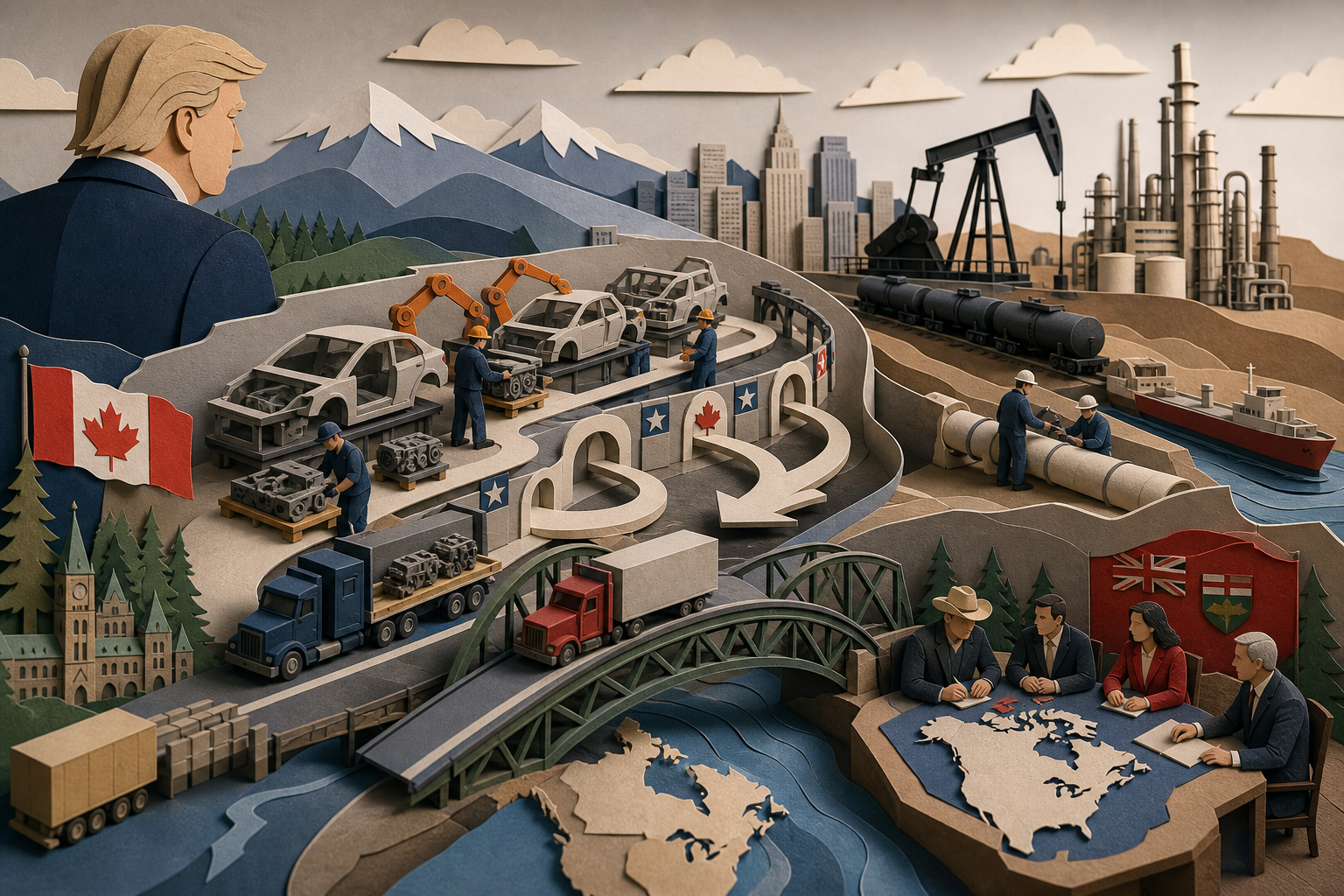
The last time an auto part crossed the Canadian border into Michigan, it had already been across that same border five times during assembly. That movement pattern, common in North American manufacturing, now faces a tax structure that could compound a 50% tariff into something closer to a 300% cumulative cost on a single finished vehicle.
President Trump's announced tariff isn't a negotiation over dairy quotas or softwood lumber. It's a direct challenge to the structural premise of the Canada-United States-Mexico Agreement, ratified in 2020 specifically to eliminate these kinds of barriers. The agreement assumed that tariff-free movement was the foundation, not a bargaining chip. A 50% levy reverses that assumption and asks whether North American integration was ever durable or just convenient during periods of political alignment.
The Compounding Cost Problem
Most Canadian exports to the U.S. are not finished consumer goods. They are intermediate inputs: crude oil refined in Texas, aluminum rolled into body panels in Tennessee, electricity that powers data centers in New York. A tariff on these goods is not just a tax on Canada. It is a tax on the cost structure of American production.
In the automotive sector, this becomes multiplication rather than addition. A stamped steel part might cross the border during initial fabrication, again after heat treatment in Ontario, a third time for sub-assembly in Ohio, and a fourth time for final integration in Windsor. Each crossing is a separate tariff event. The effective rate is not 50%. It is 50% times the number of border crossings, which in tightly integrated supply chains now averages six to eight.
The energy sector has a different problem. U.S. Gulf Coast refineries are calibrated to process Canadian heavy crude, which makes up roughly 60% of total U.S. crude imports. The refining equipment is not fungible, it cannot simply switch to light shale oil from Texas. A 50% tariff raises the input cost for gasoline production in a way that has no ready substitute, which means the cost shows up at the pump within weeks, not months.
Why the 2026 Review Clause Matters
CUSMA includes a mandatory review in 2026, at which point any of the three member states can signal an intent to withdraw or renegotiate. Trump's tariff lands eighteen months ahead of that review, which makes it less a trade measure and more a wrecking ball swung early. The standard reading is that this is an opening bid, shock-and-awe to extract concessions on dairy supply management or digital services taxes before formal talks begin.
The darker reading is that this is the administration testing whether the agreement has any enforcement mechanism at all. CUSMA's dispute resolution process requires panels, timelines, and good-faith participation. A unilateral 50% tariff imposed under a national security justification (likely citing Section 232 of the Trade Expansion Act, as in 2018) bypasses that process entirely. If it stands, the message is that treaty obligations are advisory.
The Retaliation Trap
Canada's default playbook is dollar-for-dollar retaliation, historically targeted at politically sensitive U.S. exports, bourbon from Kentucky, motorcycles from Wisconsin, orange juice from Florida. In 2018, Canada applied roughly $3.6 billion in retaliatory tariffs to steel and aluminum measures. Scaling that to a 50% tariff on 75% of Canada's export base would require tariffs in the range of $30 billion to $50 billion.
The asymmetry is the problem. Canada sends three-quarters of its exports to the U.S. The U.S. sends roughly 18% of its exports to Canada. A trade war is a war of attrition, and the smaller economy loses by definition. Retaliation becomes performative rather than strategic, necessary for domestic political credibility but insufficient to change the U.S. calculation.
What breaks next is not the tariff. It is the assumption that the borders could be opened again once the posturing ends. Supply chains that re-route do not re-route back.