Toronto's Sales Rise Hides a Sharper Story in the Suburbs

Three straight months of rising sales in Toronto sounds like recovery. Buyers are returning. Confidence is rebuilding. The housing correction might be behind us.
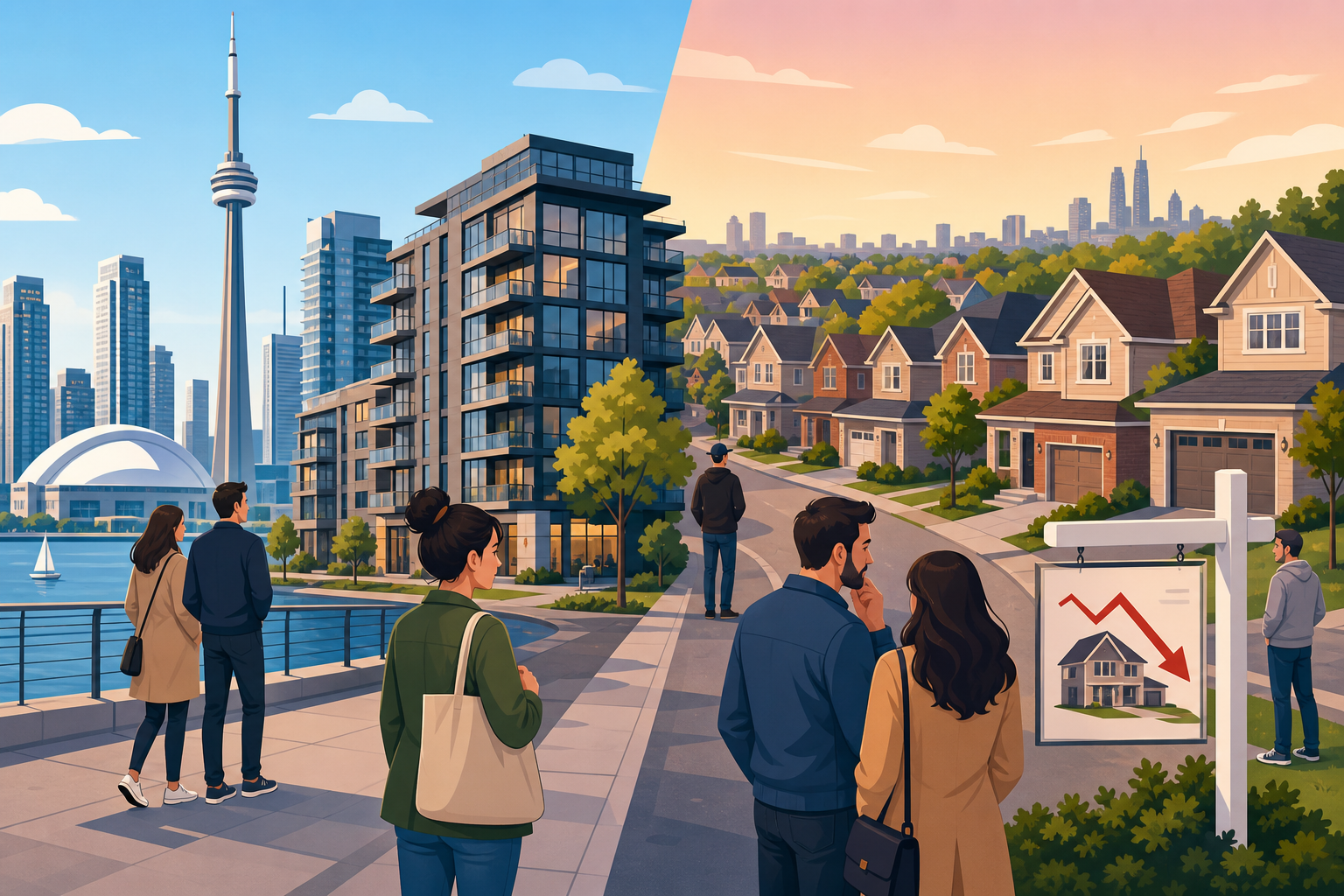
That framing is true, and it misses the sharper dynamic underneath. The GTA market isn't recovering uniformly. It's splitting. The City of Toronto proper is holding. The suburbs—the 905 belt that saw prices surge 40% during the pandemic—are correcting harder and faster than the aggregate numbers suggest.
In May 2026, roughly 7,500 transactions closed across the Greater Toronto Area. That's the third consecutive month-over-month increase, a pattern that typically signals buyers have stopped waiting for rates to drop and started buying into current conditions. But the average selling price across the GTA fell 4% year-over-year, landing in the low $1.1 million range. Sales up, prices down. That combination is what a transition from buyer's market to balanced looks like, but only if you're looking at the whole region as one market. Break it apart, and the story changes.
Durham, Peel, and Halton—the outer ring where families paid premiums for detached homes and yard space in 2021—are down 6% to 8% from last May. The City of Toronto, by contrast, is down roughly 2%. The gap is widening. Suburban sellers who bought at the peak are now sitting on homes worth less than they paid, while downtown condo owners who rode out the correction are closer to break-even or small gains, depending on the building and timing.
Why the suburbs are lagging
The pandemic created a pricing anomaly. Remote work made commute distance irrelevant, so buyers treated Oshawa and Oakville like they were ten minutes from the office. A detached house in Whitby that sold for $850,000 in early 2020 hit $1.3 million by mid-2021. That wasn't market correction. It was speculative overshoot driven by a temporary condition that has now reversed.
Return-to-office mandates didn't happen overnight, but by late 2024 most large employers in the Toronto core had locked in hybrid schedules requiring three days onsite. The 90-minute round trip that felt fine when it happened twice a month became unsustainable at twelve times a month. Buyers who can afford the downtown premium are paying it. Buyers who can't are staying closer in, which means Mississauga and Scarborough, not Milton or Clarington.
Suburban prices also inflated faster, which means they had further to fall once borrowing costs reset expectations. A buyer stretching to $1.2 million at 1.8% in 2021 could carry roughly $5,400 a month. That same buyer at 5.2% in 2024 could carry $7,100 for the same mortgage, or needed to drop the purchase price to $875,000 to keep the payment flat. The math didn't care about how much the seller needed to get out whole.
What the listing contraction means
New listings in May were down year-over-year, and that's being read as a bullish signal—less supply should support prices. But listing contraction during a price decline isn't seller confidence. It's seller paralysis. Homeowners who don't have to move aren't listing because they'd have to accept a loss or sit on market for months. The people who are listing are the ones who have no choice: job relocation, divorce, financial stress.
That creates a selection problem. The homes hitting the market aren't a representative sample of the housing stock. They skew toward either distressed situations or properties that have been sitting unsold long enough that the seller finally capitulated on price. Buyers know this, which is why rising sales haven't pushed prices back up. Volume is increasing because buyers see value at current levels, not because they expect appreciation.
If listings stay suppressed while sales keep climbing, the math will eventually tighten and force prices up. But "eventually" could be six months or eighteen. Until then, the GTA is running a two-tier market where proximity to the core is worth more than square footage, and suburban buyers who overpaid are holding longer than they planned.