Toronto Homeowners Face Renewal With No Exit: How Falling Prices Eliminate Refinancing Options

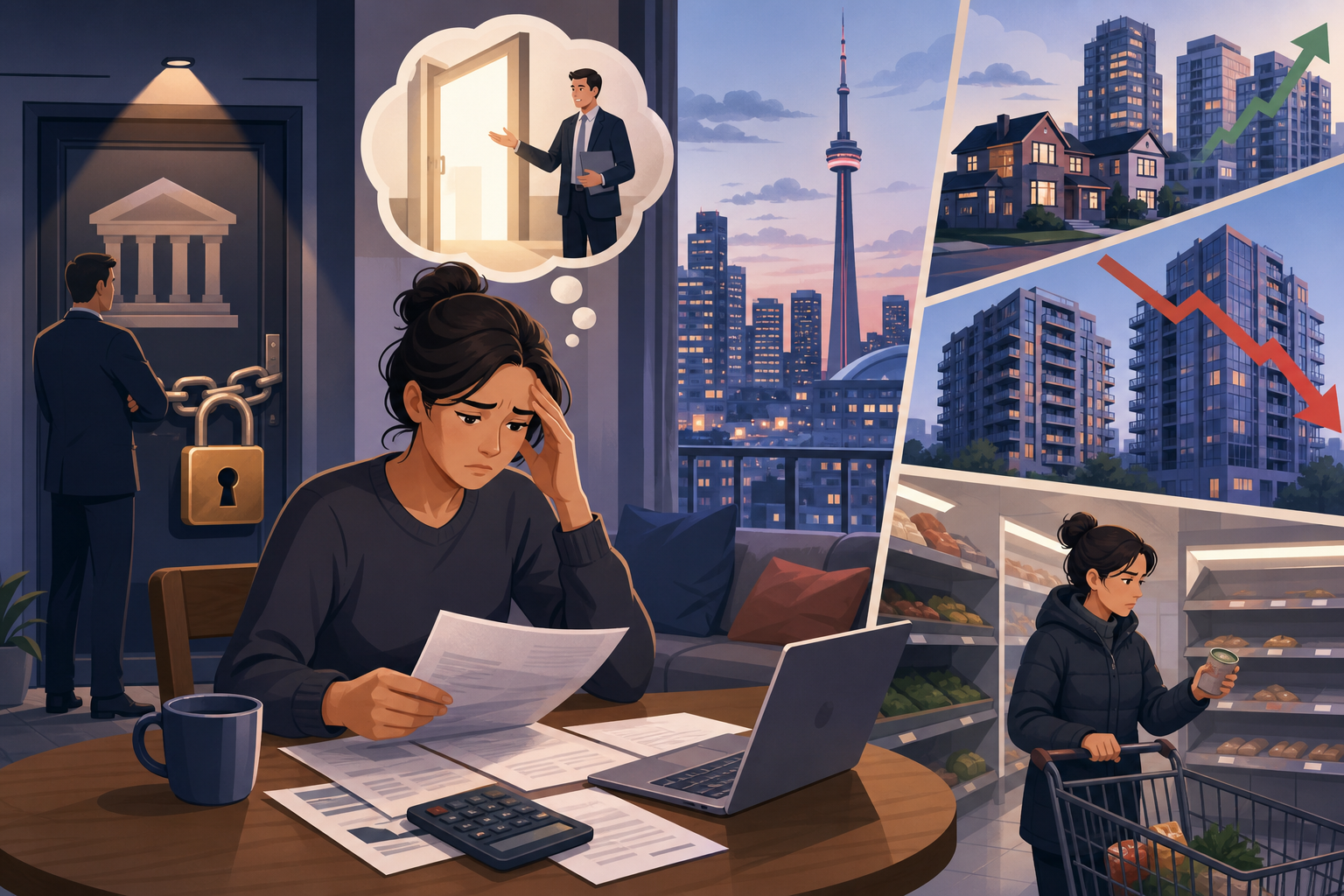
The homeowner who bought a Toronto condo in early 2022 at $720,000 now faces a problem that has nothing to do with affordability in the traditional sense. She can make the payment. She has stable employment. Her credit score is fine. The problem is that the unit is now worth $620,000, and that hundred-thousand-dollar erosion has eliminated the one tool that typically prevents mortgage stress from becoming mortgage crisis: refinancing.
Refinancing exists as a safety valve. When rates climb and payments spike, borrowers extend their amortization to smooth the shock over more years. Lower monthly burden, longer payback. The system assumes this option is always available. It is not always available. To refinance in Canada, you need at least 20% equity, because moving your mortgage to a new lender requires passing the federal stress test at the qualifying rate. Our Toronto buyer no longer has 20% equity. She has 14%. She is locked in.
The Equity Squeeze Isn't Theoretical
The Bank of Canada's June 2026 Financial System Review identifies this group explicitly: recent buyers in the Greater Toronto Area who purchased at peak prices and now hold loan-to-value ratios above 90%. The risk is described as a "tail," meaning it affects a minority of the total mortgage stock, but the minority is not small in absolute terms. Roughly 35% of all Canadian mortgages reset between 2026 and 2027. If even 8% of those involve borrowers with equity below the refinancing threshold, that's tens of thousands of households with no wiggle room.
The condo segment is worse. Detached homes in Toronto have depreciated roughly 12% from the February 2022 peak. Condos, particularly investment-grade one-bedrooms in the 416, are down closer to 18%. First-time buyers who stretched into this market with 5% or 10% down are now underwater or close to it. The price correction was predictable. The policy response was not. OSFI has held the stress test in place, prioritizing bank balance sheets over individual flexibility, which makes sense from a systemic-stability perspective and creates a disaster at the household level.
What Happens to Borrowers Who Can't Switch
The borrower with insufficient equity becomes a prisoner of her current lender. She cannot shop for better terms. She cannot access her home equity line of credit, because the line requires equity to exist. Her only option at renewal is to accept whatever rate her lender offers, and the lender knows she has no alternative. The competitive pressure that usually disciplines renewal pricing disappears. Rates for trapped borrowers can run 40 to 60 basis points higher than the best available rate in the market, purely because the borrower has no exit.
This isn't hypothetical. Mortgage brokers in the GTA are reporting a sharp uptick in clients who qualify on income but fail on equity. The payment increase at renewal averages 30% for this cohort, sometimes more. A borrower who locked in at 1.79% in 2021 and renews in 2026 at 4.8% sees her monthly payment jump from $2,100 to $2,850 on a $500,000 balance. That's $750 a month with no ability to re-amortize, no ability to switch, and no ability to extract cash if an emergency hits.
The Crisis Appears Elsewhere First
Defaults remain low because the Canadian mortgage is full-recourse. You cannot walk away. The banks can pursue your other assets, your income, everything. So borrowers don't default. They cut grocery spending, defer car repairs, stop contributing to RRSPs, and carry the payment. The distress shows up in consumer insolvency filings and retail sales data before it appears in bank foreclosure statistics. That lag makes the problem easy to underestimate until it metastasizes.
The labor market is the only firewall that matters now. If employment in Ontario stays stable, most of these households survive. If it doesn't, equity-trapped borrowers have no margin. The policy choice was made years ago when OSFI tightened lending rules without a carve-out for uninsured renewals. The bill is now due, and it's being paid by the people who bought at the top.