Recent Immigrants Pay More for Less: The Hidden Cost of Homeownership in Canada

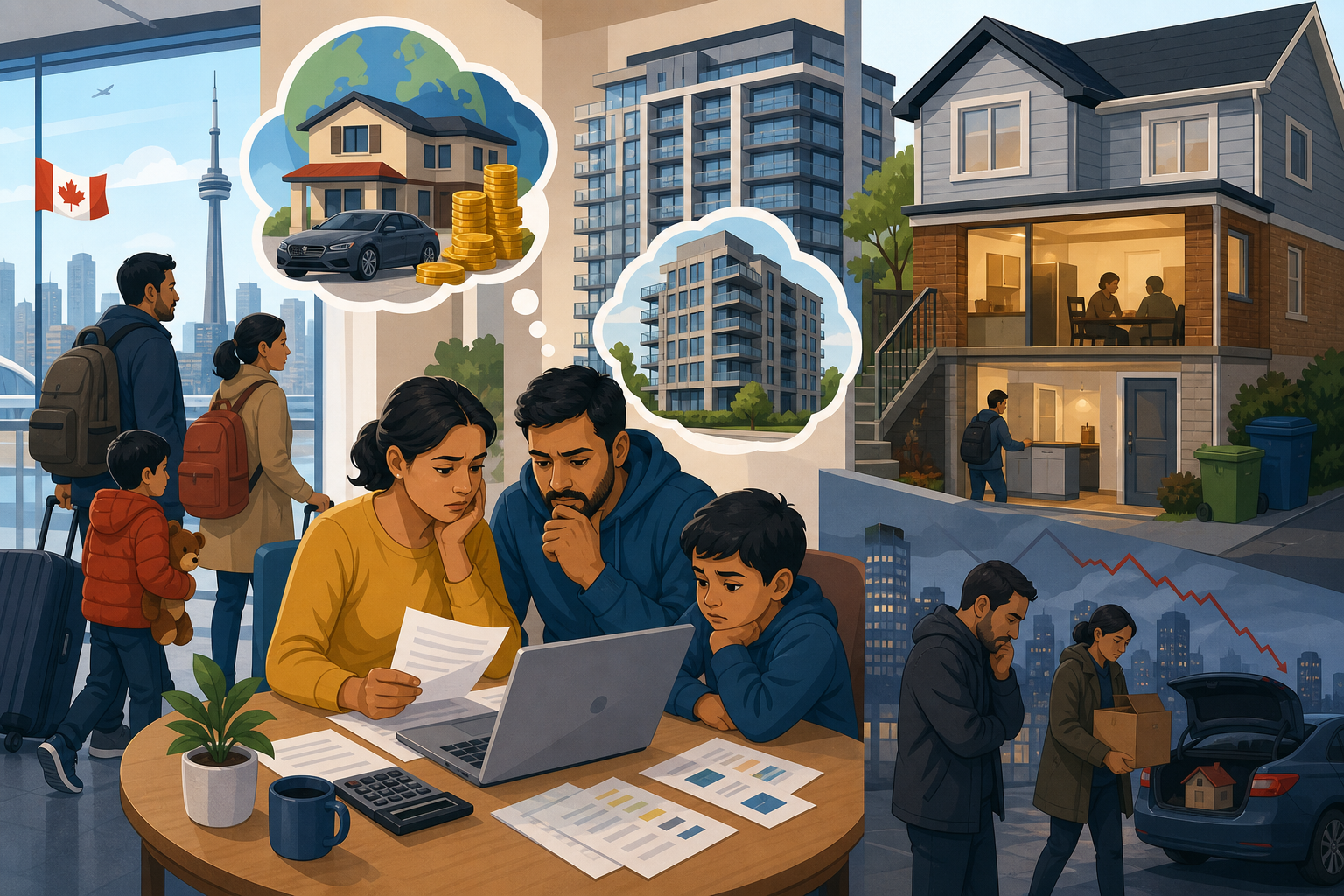
Statistics Canada data from late 2025 shows that buyers who arrived in Canada within the previous decade purchased homes valued roughly 10% higher than those bought by Canadian-born residents in Metro Vancouver. Their median household incomes were lower.
That disparity is not an anomaly. It is the structural reality of immigrant homeownership in the country's most expensive markets. The buyers stretched, not because the properties were unusually appealing, but because entry required it. A two-bedroom condo in Scarborough or a townhouse in Surrey carried a price tag that absorbed a larger share of monthly income than conventional lending wisdom would permit, yet the alternative, renting indefinitely in a market where landlords raise prices at will, felt riskier.
The mechanism is straightforward. Newcomer mortgage programs allow borrowers to qualify using alternative credit histories or liquid assets brought from abroad rather than years of domestic paystubs. A household reporting $72,000 in annual employment income might simultaneously hold $200,000 in offshore savings or receive a $150,000 gift from parents in Mumbai or Shanghai. The income-to-price ratio looks distorted because income, as captured by tax filings, is only part of the picture. Wealth is the other part, and wealth does not appear on a T4.
Where the stretch shows up
The cost is not in the purchase. It is in what happens after. These buyers allocate 40% to 50% of after-tax income to mortgage payments, property taxes, and condo fees, well above the 30% threshold lenders traditionally recommend. The margin for error shrinks. A spouse losing a job, an HVAC system failing, or a mortgage renewal at 200 basis points higher than the initial rate becomes a liquidity crisis rather than an inconvenience.
Multi-generational living and basement rental suites function as de facto risk hedges. A $3,200 monthly mortgage becomes manageable when a secondary suite generates $1,400 and an adult child contributes $800. The financial structure looks fragile on paper, but it works, until it doesn't. If the tenant leaves, or the city enforcement shuts down an unpermitted suite, the household has weeks, not months, to adjust.
The renewal problem
Buyers who locked in variable rates or short fixed terms between 2021 and early 2022 are now renewing into an environment where the Bank of Canada's benchmark rate sits multiple percentage points higher. A mortgage payment that started at $2,100 can jump to $3,400. The stress test was supposed to buffer this, but the test assumed smaller principal balances. These buyers qualified on lower incomes and purchased higher-value properties, meaning the absolute dollar increase at renewal is larger than the system modeled.
The vulnerability is concentrated. Economic Class immigrants, particularly those in tech or finance, often arrive with substantial assets and navigate renewals without issue. Family Class and some Refugee Class entrants face steeper barriers: lower starting incomes, fewer liquid reserves, and heavier reliance on income-splitting or rental income to meet payments. The label "recent immigrant" obscures a wide range of financial stability.
What the data misses
Housing as forced savings is not irrational. In Vancouver and Toronto, rent on a two-bedroom apartment can run $2,800 monthly with zero equity accumulation and no protection from annual increases. Ownership at $3,400 monthly, even stretched, builds equity and caps the largest household expense. The calculus is not "Can I comfortably afford this?" It is "Is this less risky than the alternative?" For many, the answer is yes.
The hidden cost is not in the mortgage payment. It is in the absence of financial cushion elsewhere. Emergency savings, RRSP contributions, and discretionary spending compress to near-zero. A $4,000 dental bill or a $1,200 car repair becomes a credit card balance that lingers. The homeownership does not impoverish these buyers. The stretch does.