Prince William's Land Sale Isn't Modernization — It's the Monarchy Finally Admitting It Can't Afford Itself

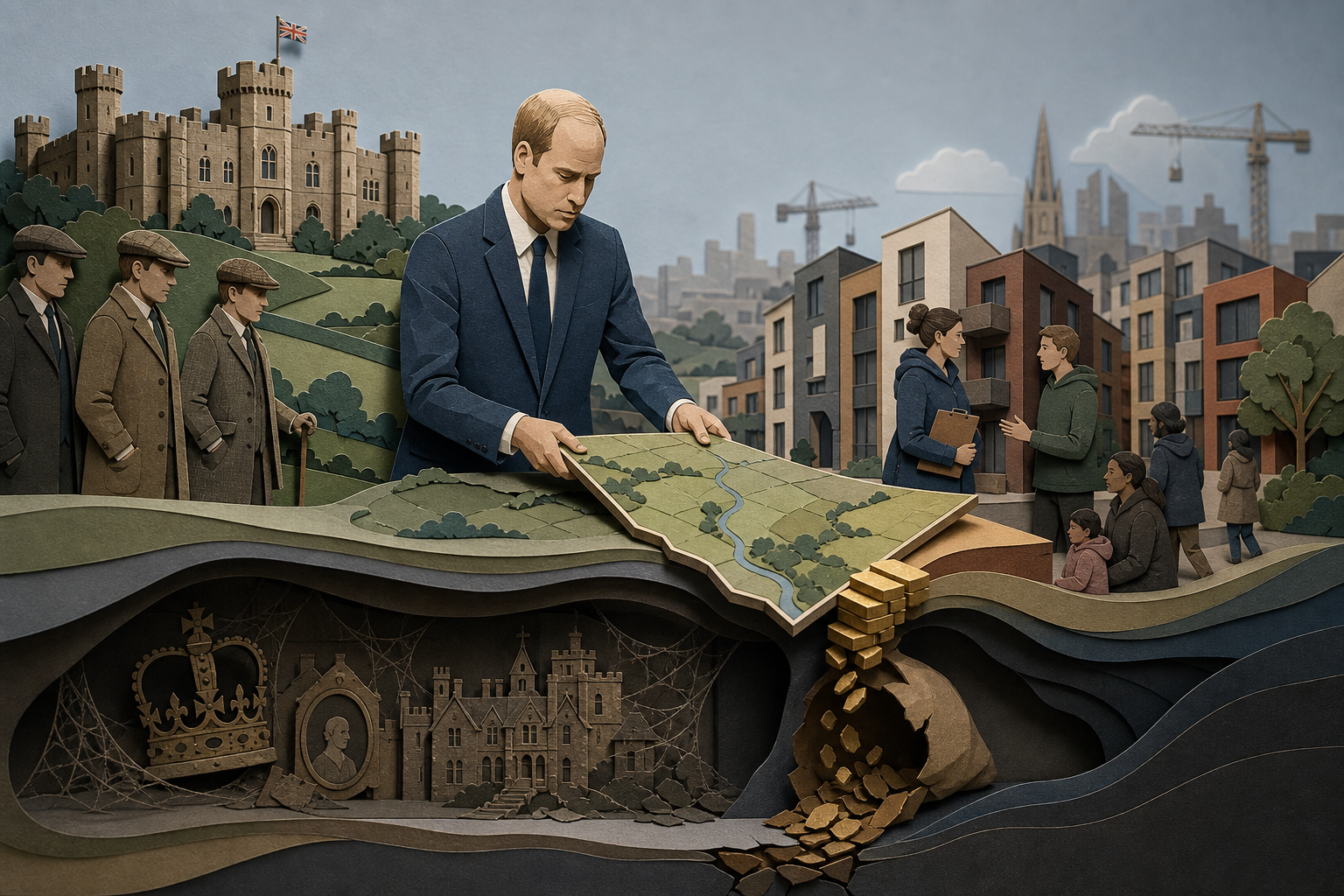
Prince William's £1.1 billion land empire is selling off one-fifth of its holdings over the next decade. The official line: modernization. Social impact. Change for good. The actual signal: the traditional model of royal finance — sit on ancient land, collect rents, pass it down — doesn't generate enough surplus to fund both the lifestyle and the causes without depleting the corpus.
The Duchy of Cornwall paid William £23.6 million in distributable surplus last year. That sounds enormous until you realize he's supposed to fund public engagements, private staff, charitable programs, and a five-year homelessness initiative called Homewards that requires capital expenditure, not just patronage. The arithmetic gets tight fast. Most aristocratic estates solve this by either going fully commercial (turn the manor into a wedding venue) or fully static (hold everything, spend nothing). William is trying a third option: liquidate a chunk of the permanent holdings to fund active programs, then hope the PR value of building 24 social homes in Cornwall justifies the loss of future rental income from those acres.
This isn't radicalism. It's triage dressed up as strategy.
The Duchy has held land since 1337. The entire structure exists to provide the heir with independent income so they're not on the civil list while waiting for the throne. For 687 years, that meant one thing: never sell. Grow the estate, improve the yields, hand it to the next Duke in better shape than you received it. Charles followed that playbook. He expanded Poundbury, invested in organic farming, and increased the surplus by 40 per cent during his tenure. William is three years in and already selling 20 per cent. That's not a stylistic difference. That's a funding gap.
The problem is that "social landlord" and "private estate funding a royal household" are incompatible business models. A social landlord builds below-market housing and operates on thin or zero margins because the mission is public benefit. A private estate maximizes returns to support its beneficiary. The Duchy is trying to do both with the same land base, and the math doesn't close. The 24 homes in Nansledan are real and useful. They're also a rounding error against the UK's 271,000-household homelessness figure. To make a dent at scale, William would need to convert hundreds of acres to social housing, which would crater the surplus and leave future Dukes broke.
So instead, he's selling land to fund programs. That works once. When the land is gone, the programs either stop or require new funding, and the estate is smaller. The next Duke of Cornwall inherits 20 per cent less territory, 20 per cent less future optionality, and the expectation that they'll maintain the same level of public engagement with a structurally smaller base. That's not sustainable. That's a drawdown.
Here's the objection: maybe William genuinely doesn't care about preserving the estate intact for his son. Maybe he's decided homelessness is urgent enough to justify spending down permanent capital. Fine. That's a defensible moral position. But if that's the play, the framing should be honest. "I'm choosing to reduce the Duchy to fund immediate social programs because the need is acute and the monarchy should contribute" is a real argument. "I'm modernizing the estate through strategic divestment" is consultant-speak for "the current revenue model doesn't support the expected output."
The monarchy's financial position has been quietly deteriorating for decades. The Crown Estate pays 25 per cent of its surplus to the Sovereign Grant, which funds working royals. That grant was £86.3 million in 2023-24, spread across a shrinking pool of active royals doing an expanding workload. Streamlining the firm means fewer people doing more, funded by a static or slowly growing revenue base. The Duchy was supposed to be the hedge — independent income for the heir that doesn't rely on Parliament or public subsidy. If even that estate needs to liquidate holdings to make the sums work, the underlying model is broken.
William isn't selling land to modernize the monarchy. He's selling land because the monarchy, as currently structured, costs more to operate than its historical revenue streams can cover without either increasing public subsidy or depleting private assets. The land sale is the depletion option. It's quieter than asking for a bigger grant, but it's not more sustainable.