Malaysia's Defense Calculus: Why Kuala Lumpur Is Choosing Asymmetric Capability Over Budget Expansion

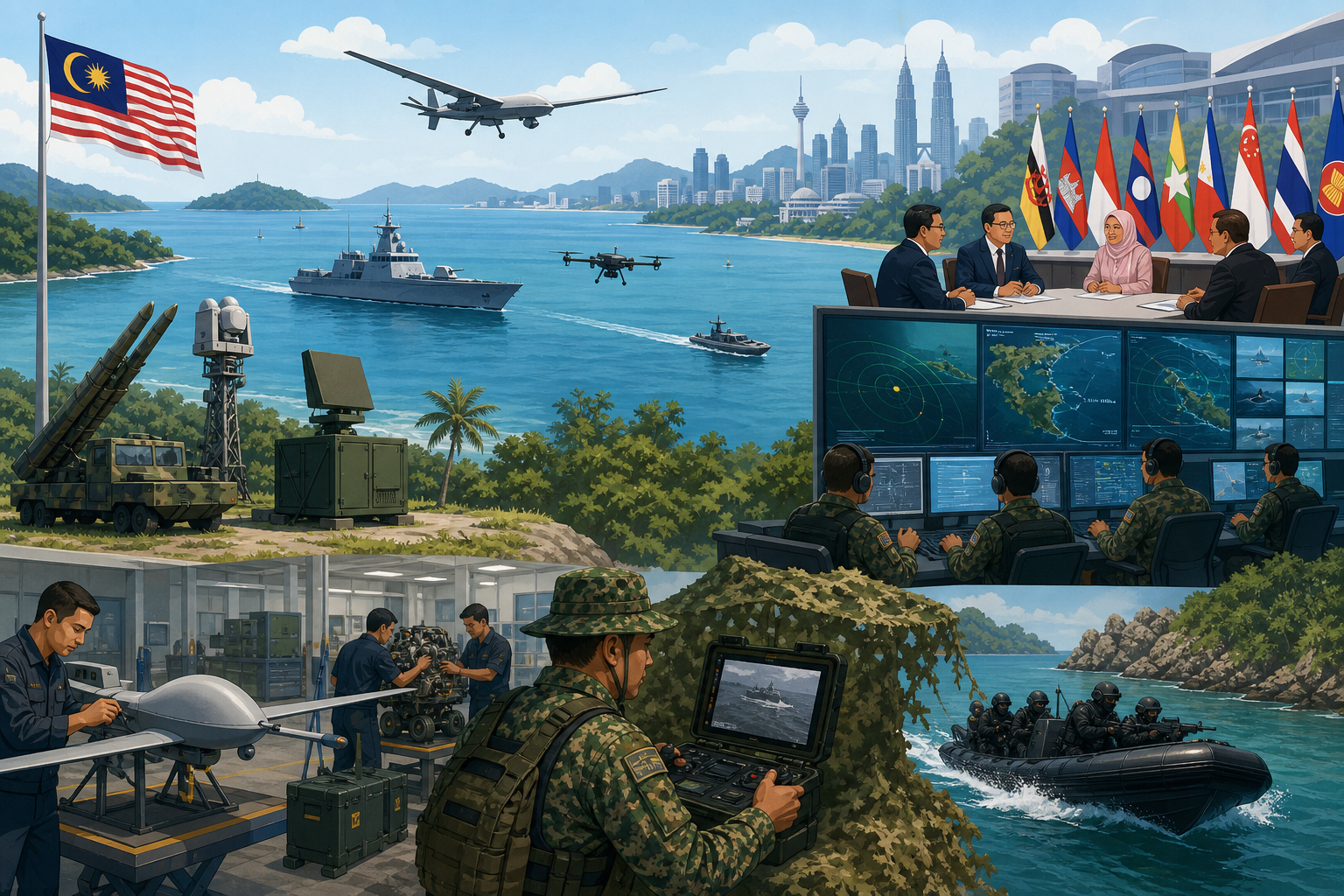
Malaysia's 2025 defense allocation sits at RM19.7 billion—1.1% of GDP. That's roughly half the global average. For a middle power with overlapping South China Sea claims and a maritime perimeter stretching from the Straits of Malacca to the Sulu Sea, the number looks thin. It is also deliberate. Defense Minister Mohamed Khaled Nordin confirmed in early 2025 that Malaysia will not accelerate military spending in response to U.S. calls for Indo-Pacific partners to shoulder more of their own defense burden. The decision reflects a different calculus. Kuala Lumpur is not trying to match regional rivals ship-for-ship or jet-for-jet. It is building a deterrent based on denial, not domination. The Ministry of Defence calls this asymmetric warfare. The term covers a range of cheaper, tech-forward capabilities designed to make aggression prohibitively expensive without bankrupting the defender. Coastal missile batteries, electronic warfare systems, and drone swarms cost a fraction of what frigates or fighter squadrons do. They also exploit a structural advantage: it is easier to prevent an adversary from projecting power into contested waters than it is to project power yourself. Singapore and Indonesia are both modernizing faster. Singapore's defense budget runs at roughly 3% of GDP. Indonesia recently committed to a $125 billion modernization plan spanning submarines, fighters, and amphibious assets. Malaysia's approach looks passive by comparison. But the logic holds if the objective is stability rather than capability competition. Malaysia's geographic position creates an asymmetry that budget size does not capture. Control of the Straits of Malacca—through which roughly 25% of global traded goods pass—gives Malaysia leverage that does not require carrier strike groups to activate. The credible threat of disruption, even temporary, is itself a deterrent. A network of land-based anti-ship missiles positioned along the coastline achieves that credibility at a cost measured in millions, not billions. The domestic context reinforces the restraint. Over 60% of Malaysia's defense budget goes to operating expenditure—salaries, pensions, and maintenance of aging platforms like the Sukhoi Su-30MKM fleet. What remains for procurement is further constrained by fiscal discipline following the post-pandemic recovery and subsidy rationalization efforts that began in 2024. The national deficit needs to shrink. Defense is not exempt. The Littoral Combat Ship (LCS) program casts a long shadow here. Delays, cost overruns, and eventual scandal turned what should have been a straightforward naval procurement into a political liability. The first vessel is now expected in 2026, years behind schedule. Public tolerance for large-ticket defense acquisitions has dropped. The Ministry of Defence knows it. What Kuala Lumpur is betting on instead is that true security for a middle power comes from solvency, not hardware. A debt-ridden state with advanced equipment is easier to pressure than a fiscally stable state with modest but operational assets. The Royal Malaysian Navy's CAP55 transformation roadmap extends to 2055, not 2030. The timeline signals patience, not urgency. Diplomacy does the rest. Malaysia remains non-aligned in the U.S.-China rivalry despite being one of China's largest trading partners and hosting overlapping territorial claims in the South China Sea. ASEAN remains the primary diplomatic shield. De-escalation through multilateral frameworks reduces the scenarios where hard power would even be required. The risk is obsolescence. Asymmetric capabilities assume a certain kind of threat—one that relies on conventional projection and can be denied through area denial. If the threat evolves, the gap between Malaysia's current posture and what would be needed widens. But for now, Kuala Lumpur is choosing the budget it can afford over the budget it might someday need.