Malaysia's Asymmetric Defense Strategy Rejects US Pressure for Conventional Buildup

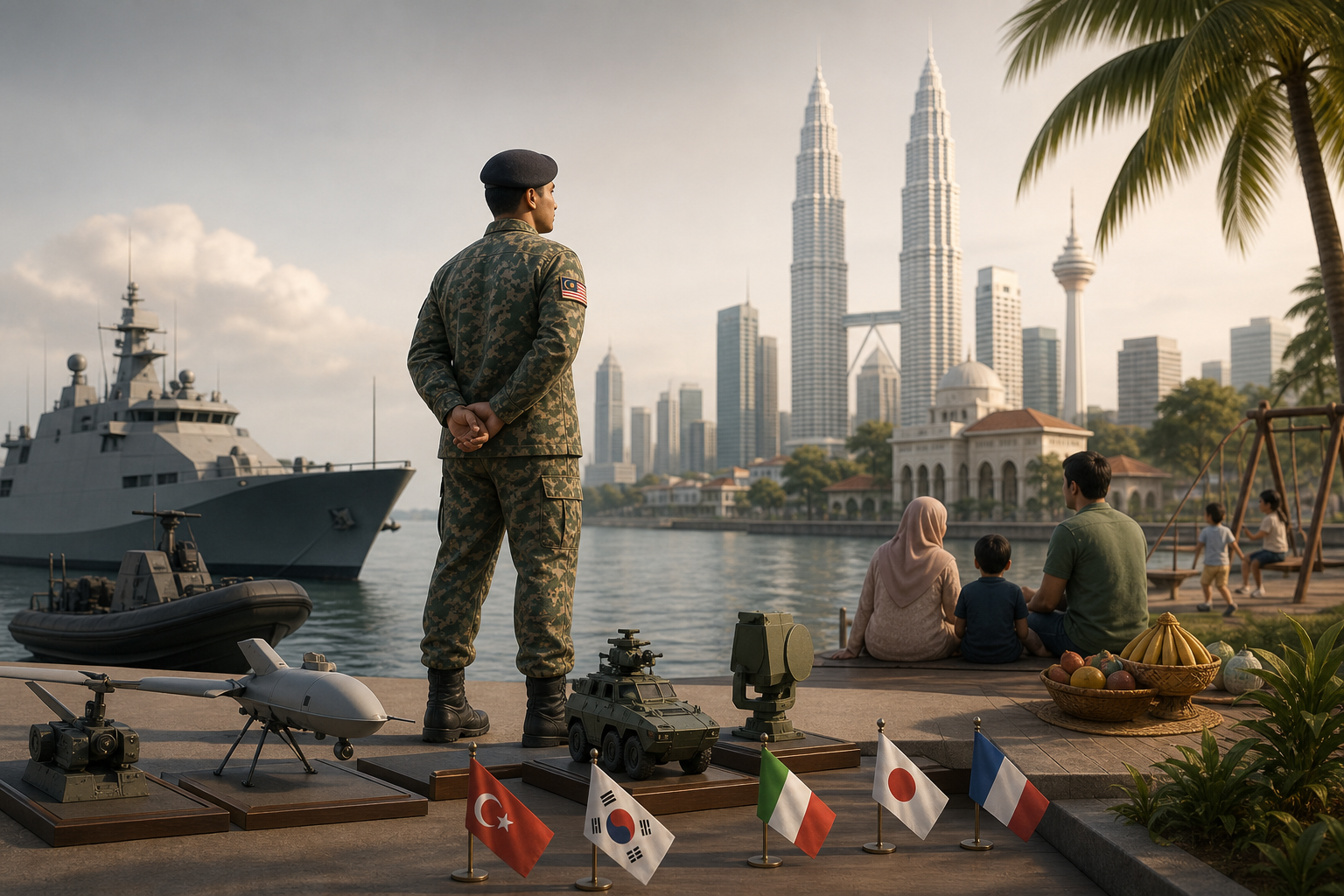
Malaysia has decided it will not accelerate defense spending in response to US calls for Indo-Pacific partners to shoulder a larger share of regional security costs. The position, articulated by Defense Minister Mohamed Khaled Nordin, reflects a deliberate choice: the government views military modernization as one priority among several, not the dominant one.
The United States has been encouraging allies in the region to reduce dependence on American military support by building their own conventional capabilities. For Malaysia, that pressure translates into an expectation of higher budgets, larger fleets, and a posture that mirrors what Western defense planners consider credible. Malaysia's response has been to reject the premise.
The national defense budget typically sits between 1% and 1.1% of GDP, well below the global average of roughly 2.3%. Within that allocation, around 70% to 75% goes to Operating Expenditure—salaries, maintenance, keeping aging assets functional. Development Expenditure, the portion available for new procurement, is less than 30%. This is not a government that has room to fund a conventional arms race without cutting healthcare, education, or domestic subsidies that keep the cost of living manageable.
The shift toward asymmetric capabilities
What Malaysia is doing instead is reorienting its defense strategy around asymmetric warfare. Asymmetric, in this context, does not mean guerrilla tactics. It means choosing technologies that achieve strategic effects at a fraction of the cost of traditional platforms. Drones, surveillance systems, cyber-defense infrastructure, and coastal sensors provide situational awareness across Malaysia's exclusive economic zone without requiring a blue-water navy to patrol it.
This is not a purely military calculation. It is a budget-management strategy. A destroyer costs hundreds of millions of dollars to acquire and tens of millions annually to maintain. A network of UAVs and radar installations provides comparable coverage of the South China Sea for a lower capital outlay and operational cost. The asymmetric approach is not ideological. It is pragmatic.
The Defence White Paper, which guides Malaysia's 10-year transformation plan toward a "Credible Force" by 2030, frames this shift explicitly. The goal is not to match a superpower's tonnage. The goal is to make intrusion or encroachment costly enough that deterrence holds without Malaysia needing to win a conventional fight.
Why Malaysia is not aligning
Malaysia's refusal to rush spending is also a sovereignty signal. The country maintains a policy of non-alignment and strategic autonomy. It has overlapping territorial claims with China in the South China Sea, but it also has substantial trade ties with Beijing. It values US security cooperation, but it does not want to become a forward operating base in a superpower competition. The middle path requires keeping defense policy independent of external pressure.
When Nordin emphasizes that military modernization cannot come at the expense of critical sectors, he is describing a social contract. The Malaysian government's legitimacy rests in part on delivering economic stability and public services. A sudden increase in defense spending, framed as alignment with US strategic goals, would be read domestically as prioritizing Washington's interests over local needs.
The LMS Batch 2 procurement—Littoral Mission Ships acquired from Turkey—illustrates the diversification strategy. Malaysia is not cutting ties with Western suppliers or Chinese manufacturers. It is spreading procurement across multiple partners to avoid dependence on any single source. Turkey, South Korea, and Italy have all become viable alternatives to the traditional US-Europe-China triangle.
There is risk in this approach. Critics argue that not rushing leaves capability gaps as neighbors modernize rapidly. Singapore, Indonesia, and Vietnam are all upgrading their fleets. Malaysia's reluctance to match that pace could mean obsolescence, especially as the bulk of the current budget goes to maintaining 30-year-old platforms rather than replacing them.
But the counter-risk is also real. Rushing to spend under external pressure creates dependencies, locks in partnerships that constrain future policy, and diverts resources from the economic foundation that makes defense spending sustainable in the first place. Malaysia has chosen the slower path, and it has framed that choice as a decision made in Putrajaya, not dictated by competition between powers that see the region as a chessboard.