Malaysia Declines US Defense Budget Push, Banks on Asymmetric Strategy Instead

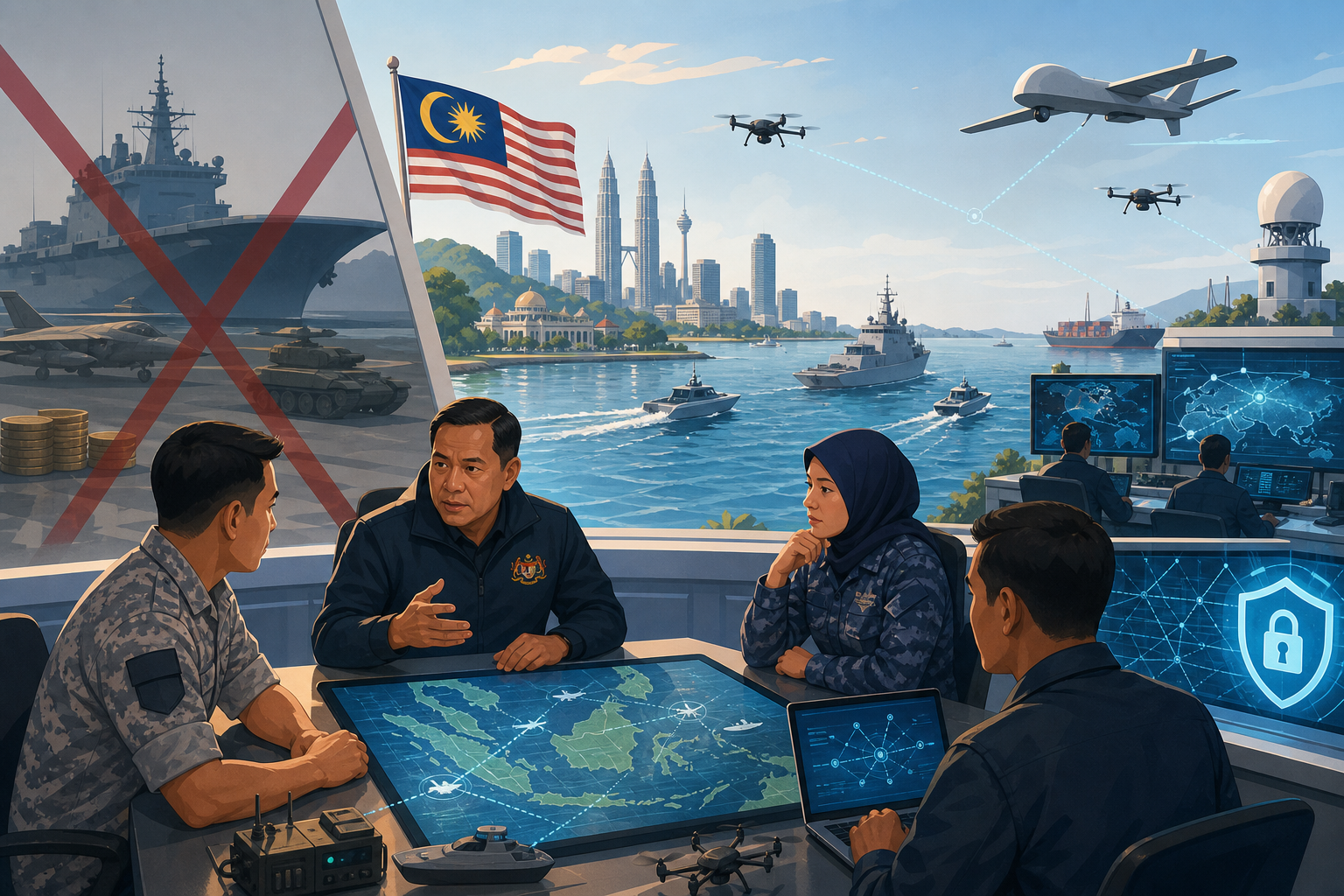
Malaysia's defense ministry rejected American pressure to accelerate military spending this month, choosing instead to double down on what Minister Mohamed Khaled Nordin calls "asymmetric warfare"—a technical term for making aggression expensive without matching an adversary's firepower. The decision reflects a structural constraint most commentary misses. Malaysia does not face the typical choice between guns and butter. It faces the choice between credible maritime deterrence and fiscal solvency, in a country where over 25% of GDP moves through the Malacca Straits but national debt consolidation remains the primary macroeconomic objective through 2027. Spending like Singapore or Indonesia—regional peers now pushing defense budgets above 2% of GDP—would require either cutting subsidies that keep diesel and RON95 petrol affordable, or abandoning the government's target of a sub-4% fiscal deficit. Asymmetric strategy is not a euphemism for doing less with less. It is a doctrine: you cannot afford the destroyers and fighter wings a larger power fields, so you invest in the systems that make deploying those assets prohibitively risky. Naval mines that cost $50,000 each can disable a $2 billion frigate. Surveillance drones operating from land bases eliminate the need for expensive carrier groups to patrol an Exclusive Economic Zone. Cyber capabilities that can disrupt command-and-control networks cost a fraction of a tenth-generation stealth aircraft and, in certain scenarios, deliver higher strategic value. Malaysia has structured its Defense White Paper around this math since 2020. The current cycle runs through 2030 and emphasizes indigenous production—Littoral Mission Ships built in Malaysian shipyards, UAV programs staffed by local engineers, cyber units that do not depend on foreign contractors for critical infrastructure. The ministry is not trying to win a war of mass. It is trying to make the cost of starting one unacceptable. The two-theater problem complicates everything. Peninsular Malaysia and the East Malaysian states of Sabah and Sarawak sit on opposite sides of the South China Sea, requiring separate logistics, separate air coverage, and separate rapid-response capability. Defending both against a peer adversary is not viable under current spending. Defending both against incursion, piracy, and low-intensity threats is. The ministry's position is that the latter threat profile is the one Malaysia actually faces, and outfitting for the former would bankrupt the country while solving a hypothetical. Washington's "burden-sharing" push assumes that higher spending correlates with higher security. Malaysia's position is that unaffordable spending creates a different kind of vulnerability. A military that cannot maintain its platforms, cannot recruit skilled operators because defense wages are uncompetitive, or cannot modernize systems because debt service crowds out procurement—that is a weaker force than one half the size but fully funded. Khaled Nordin's framing is revealing: he does not say Malaysia will never increase defense spending. He says it will not rush. The distinction matters. Rushing implies external timelines, external priorities. The current approach treats defense modernization as a multi-decade infrastructure problem—like building ports or upgrading power grids—that must be sequenced with food security, healthcare, and education rather than funded in isolation. The South China Sea remains contested, overlapping claims unresolved. Malaysia's response has been quiet exploration agreements and restrained diplomatic signaling, not overt military posturing. That is not passivity. It is a bet that sovereignty is better defended through a functioning economy and smart deterrence than through hardware Malaysia cannot afford to operate at scale.