Loop's Returnable Packaging Thrived in France But Died in Canada: The Missing Infrastructure Nobody Mentioned

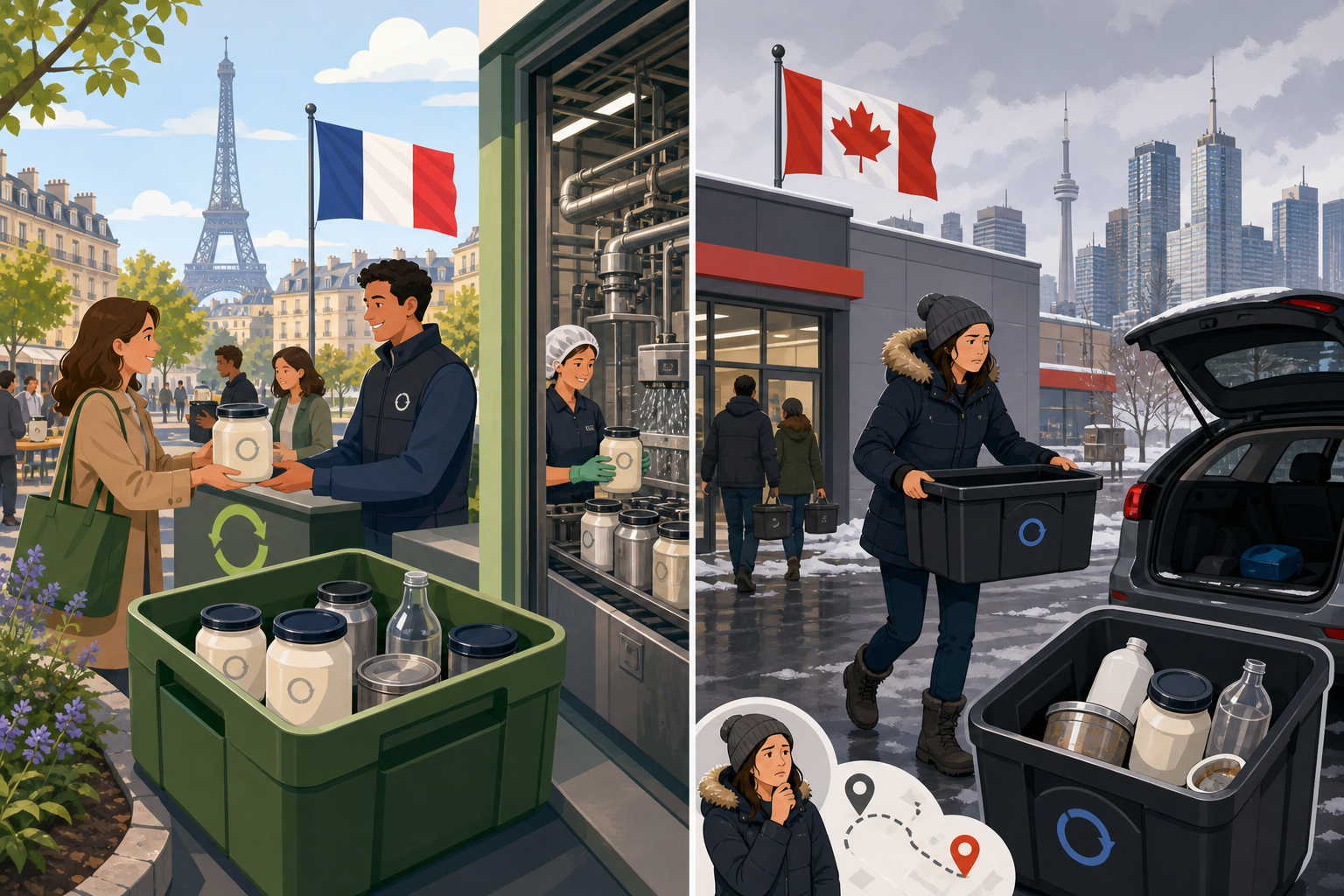
In 2021, Loblaw stopped taking back Loop containers. The company ran the pilot for two years and concluded it "did not achieve scale and economic viability." That was polite corporate for: customers didn't use it enough, and the infrastructure cost more than anyone budgeted.
Meanwhile, France now has 5,000 refillable products across multiple grocery chains, and Tom Szaky's Loop is not only operational but expanding. Same concept. Same returnable packaging model. Same CEO. One country made it work. The other killed it quietly. The difference wasn't consumer interest.
The Infrastructure You Can't See From the Storefront
Loop's premise was simple: replace single-use plastic with durable containers customers return for cleaning and refilling. Think milk delivery, but for shampoo, laundry detergent, and ice cream. In Canada, the pilot required customers to bring Loop-branded bins back to specific Loblaw locations. The company would collect, sort, ship the containers to a central facility, clean them, ship them back to suppliers, and repeat.
That last part—the cleaning loop—is where the model collapsed. Canada has no shared sterilization infrastructure for diversified reusable packaging. Every container type needed its own handling protocol. Heavy glass jars for pasta sauce couldn't run through the same line as steel detergent bottles. Building out that capacity for a two-year pilot wasn't viable, so Loop relied on a patchwork of third-party processors, each adding transport emissions and cost.
France didn't invent new technology. It passed a law. The AGEC Law (Anti-Waste for a Circular Economy) mandates that 10% of all packaging placed on the French market be reusable by 2027. That forced brands and retailers to stop treating reusables as a side project and start investing in the reverse logistics backbone: centralized washing facilities, standardized container specs, and municipal return points. The law didn't ask companies to volunteer. It required them to build.
Standardization Is the Part Nobody Wants to Talk About
The logistical nightmare of reusable packaging isn't collection. It's diversity. Every brand designs its own bottle shape for shelf differentiation. Heinz wants a jar that looks different from Hellmann's. But reuse at scale requires the opposite: Heinz and Hellmann's using the exact same jar so both can run through the same sterilization line. That's a marketing disaster framed as an environmental necessity.
France is moving toward that. Szaky now emphasizes "eco-design" principles—a code phrase for making brands surrender their vanity packaging in favor of standardized formats. In Canada, that conversation never got far enough to become uncomfortable. The pilot ended before brands had to choose between differentiation and infrastructure efficiency.
Without standardization, every new product added to Loop's catalog was an incremental complexity cost. Each required its own return bin, its own cleaning protocol, its own spare inventory buffer. The model doesn't scale under those conditions. It fragments.
The Carbon Math That Doesn't Get Mentioned
A reusable container only beats single-use plastic if it's actually reused. The break-even threshold sits somewhere around 10 to 15 cycles, depending on material. Below that, the emissions from manufacturing a heavy glass jar and trucking it back and forth across Ontario exceed the emissions saved by avoiding virgin plastic.
Loop's Canadian return rate never hit the 90% threshold required to make the environmental case work. Containers leaked out of the system—forgotten in basements, tossed because the return location was inconvenient, or simply kept by people who liked the jar. In France, curbside collection programs mimic the ease of curbside recycling, which keeps return rates high. In Canada, asking someone to drive back to the grocery store with a bag of empty containers introduced friction the system couldn't survive.
The infrastructure gap wasn't just washing machines. It was the last-mile return experience. Without municipal buy-in, that friction stayed high, and the model stayed unviable.
The French version didn't win because French consumers care more about sustainability. It won because the government built the scaffolding that made caring easy.