Halifax's housing crunch now costs 22% more if you want a good school nearby

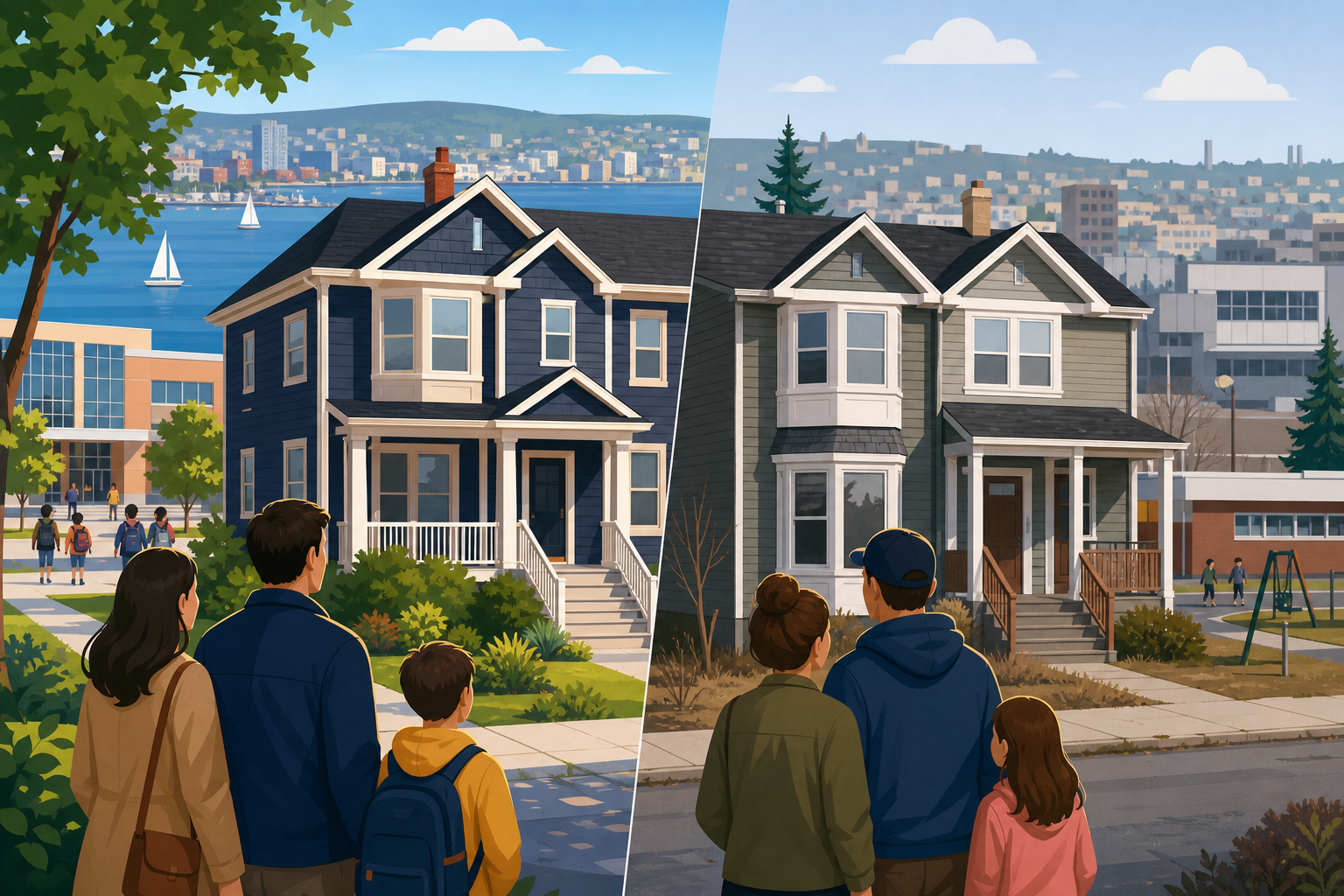
A semi-detached in Halifax Peninsula North listed for $789,000 sits four blocks from a school ranked in the province's top tier. The same house, same square footage, same year built, same condition, six kilometers south near a middling catchment area goes for $647,000. That $142,000 gap wasn't there eighteen months ago.
The data firm Properly analyzed 2,347 sales in Halifax Regional Municipality between January 2023 and October 2024. Properties within 500 meters of schools scoring above the 75th percentile in provincial standardized test results commanded an average premium of 22% over comparable homes near schools below the 50th percentile. In March 2023, that premium sat at 14%. The spread widened as inventory tightened and families with school-aged children started competing for a shrinking pool of listings that checked both boxes: affordable and academically defensible.
Why the gap widened when inventory dropped
Halifax's active listings fell from roughly 2,100 units in early 2023 to under 1,400 by mid-2024. When supply contracts, buyers sort themselves by what they can't compromise on. Retirees and single professionals can live anywhere. Parents with an eight-year-old can't. The result: bidding wars in Hydrostone and the North End, while areas like Spryfield saw prices flatten or drift down. The housing crunch didn't hit all neighborhoods equally because all buyers don't have equal constraints.
The school premium isn't new. Every major Canadian city has one. What changed in Halifax is the speed. Toronto's catchment premium took a decade to hit 25%. Vancouver's sits around 30% but built over fifteen years as the city densified. Halifax went from 14% to 22% in nineteen months. That kind of acceleration typically signals either a supply shock or a demand surge from a specific demographic cohort. Halifax got both: inter-provincial migration brought families from Ontario and British Columbia, and the municipality approved fewer housing starts in 2023 than in any year since 2017.
The mortgage rate layer makes it worse
A $647,000 house at 5.5% on a 25-year amortization with 20% down costs roughly $3,440 monthly. The $789,000 house costs $4,200. That $760 difference per month, $9,120 annually, compounds over the life of the mortgage into six figures. If you refinance once at a higher rate, the total cost gap widens further. Parents who stretched to afford the premium in 2023 are now locked into payments that assume their income kept pace with inflation. For many, it didn't.
The real policy failure here isn't that good schools cost more. It's that the supply response has been so slow that the premium became a barrier instead of a signal. In functional housing markets, a 22% premium for proximity to a desirable amenity should trigger construction within that catchment area. Developers should flood the zone with townhouses and mid-rise condos. Families should have options besides bidding against each other for the same sixty-year-old bungalows.
That hasn't happened. Halifax's planning approvals process remains glacial, and the neighborhoods with top-ranked schools tend to have restrictive zoning that blocks density. So the premium persists and widens, and the families who can't pay it either leave the city or settle for schools that weren't their first choice.
The $142,000 question isn't whether parents should care about schools. It's whether a city can sustain a housing market where educational access depends on winning a bidding war.