Guyana's Oil Boom Just Got a Geopolitical Accelerant

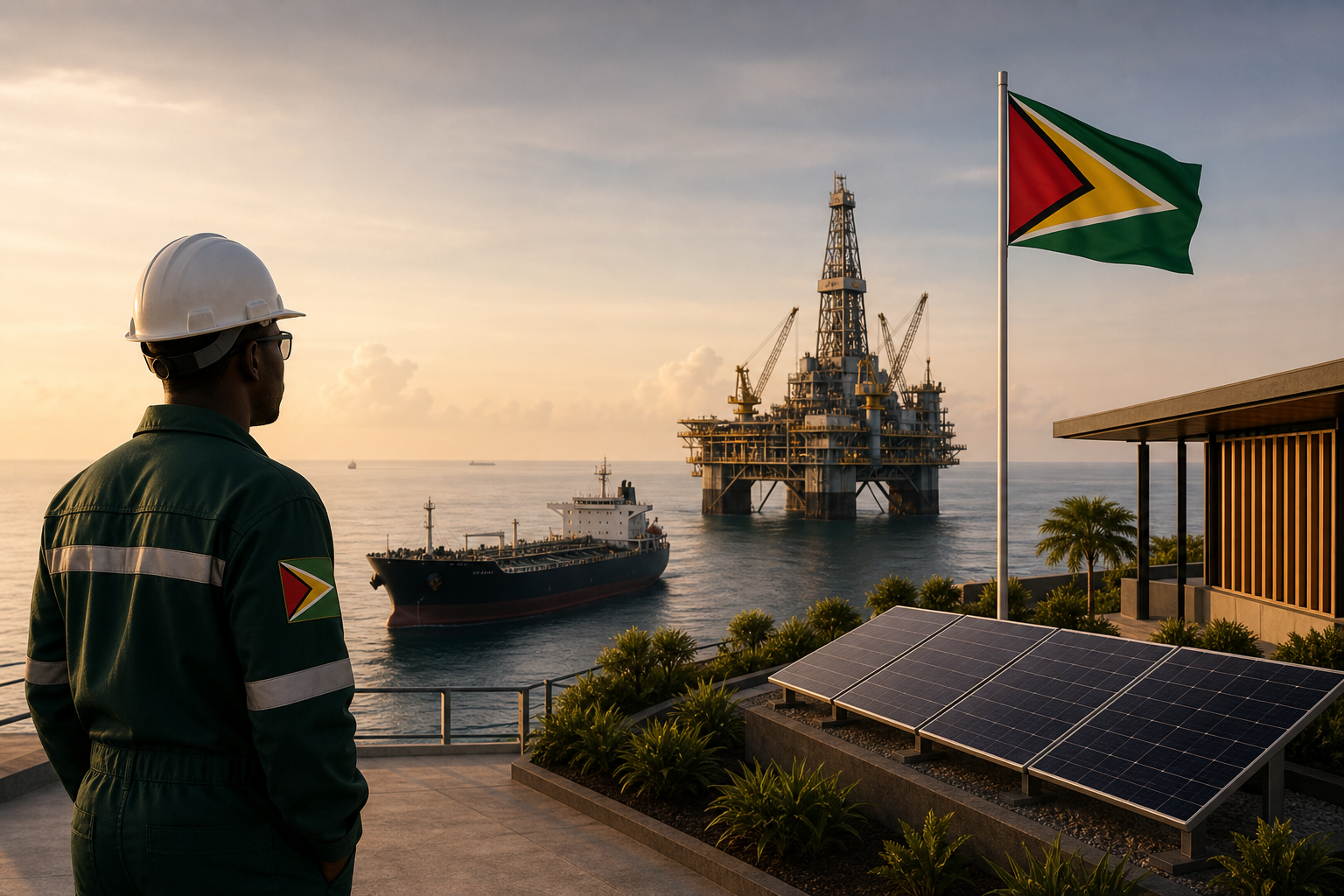
Guyana's offshore oil deposits were already delivering the world's fastest GDP growth before the Middle East erupted. Now, military strikes on Iranian facilities have pushed Brent crude past $90 per barrel, and the government in Georgetown is watching its Natural Resource Fund swell faster than its infrastructure can absorb the money.
The mechanism is straightforward. Guyana receives royalties and profit oil from the Stabroek Block—a 6.6 million-acre offshore tract operated by ExxonMobil, Hess, and CNOOC. Profit oil is what remains after the operator recovers costs, capped at 75% of production under the current Production Sharing Agreement. When crude prices spike, the revenue split tilts harder toward the government even though the country's production volume hasn't changed. A $10 increase in the global benchmark translates to roughly $240 million more per year at current extraction rates, assuming cost recovery stays constant.
The Iran factor matters because it creates a risk premium Guyana doesn't have to earn. Strikes on Kharg Island or tanker disruptions in the Strait of Hormuz push buyers toward suppliers outside the Persian Gulf. Guyana's medium-to-light sweet crude—low sulfur, easy to refine—becomes comparatively more attractive to European and Gulf Coast refiners without the government lifting a finger. The country isn't producing more oil. It's just benefiting from a supply chain rerouting it had no role in creating.
Production is scaling regardless. Daily output crossed 645,000 barrels in early 2024 and is trending toward 800,000 barrels by late 2025 as the Payara and Yellowtail projects ramp. By 2027, the target is 1.3 million barrels per day—larger than the entire North Sea at its peak. ExxonMobil has described the block as one of the most capital-efficient offshore developments globally, with break-even costs below $35 per barrel. At $90, the margin is absurd.
The problem is absorptive capacity. Guyana has a population of 800,000. The government is funneling oil revenue into the Public Sector Investment Program, which includes the Gas-to-Energy project at Wales—a combined-cycle plant meant to cut electricity costs that currently run higher than anywhere else in the Caribbean. But there's a ceiling to how much concrete, steel, and labor a small economy can deploy without triggering inflation or waste. The Bank of Guyana is targeting 5% inflation for 2025, but that assumes the fiscal withdrawal from the Natural Resource Fund stays disciplined. The sliding-scale rule governing NRF drawdowns allows more spending when oil prices rise. Higher prices mean more temptation.
The windfall also creates a geopolitical opening Venezuela would prefer didn't exist. The Essequibo region—roughly two-thirds of Guyana's territory, including the offshore waters where Stabroek sits—remains under formal dispute. Venezuela has historically treated the claim as dormant leverage, but Guyana's rising importance to U.S. and European energy security changes the diplomatic calculus. The Biden administration backed Guyana publicly during the most recent flare-up in 2023. Higher oil prices make that support stickier.
What's less visible is the revenue lag. Guyana doesn't collect profit oil in real time. Revenue arrives when tankers are loaded and shipments are sold—sometimes weeks after the price spike that caused the media coverage. Cost recovery also delays the government's share. Until ExxonMobil and its partners clear roughly $9 billion in development expenses, up to 75% of production goes to cost oil, not profit oil. The windfall is real, but the accounting is slower than the headlines.
The deeper risk is price reversal. If Iran negotiations succeed or global demand softens, Brent could drop $20 in a quarter. Guyana's fiscal framework anticipates volatility, but the political pressure to spend doesn't. A government that built a power plant assuming $85 crude has a problem at $65.