Greater Sudbury, Timmins, Thunder Bay: Why Mining Investment Is Reshaping Northern Ontario Real Estate in 2026

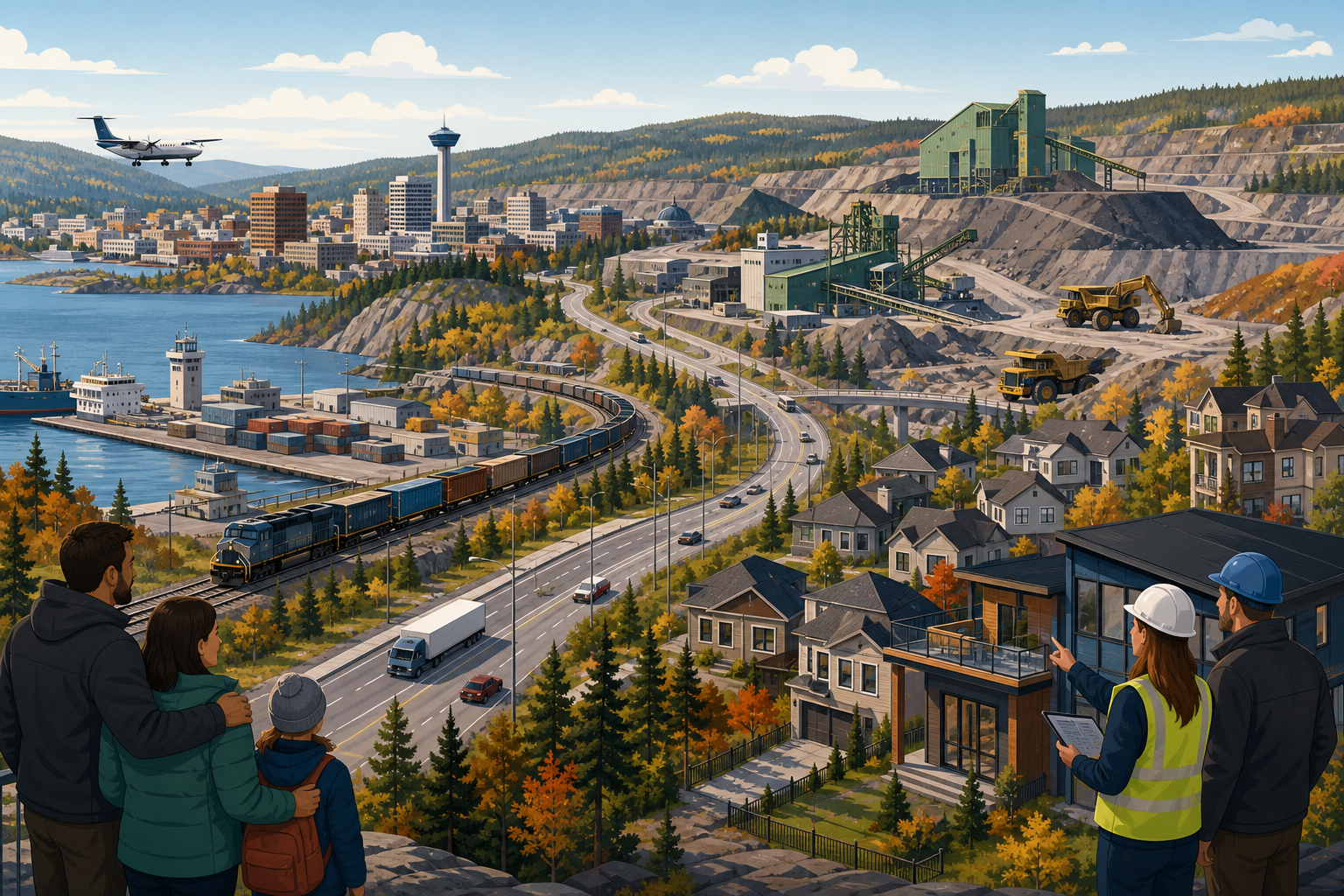
A single-family home in Sault Ste. Marie still sells for under $350,000. In Greater Sudbury, the median purchase price sits 40 to 50 percent below the provincial average. Thunder Bay recorded net positive migration for the second straight year. These are not the markets that dominate headlines, but they are the ones where the structure of demand has quietly changed.
The shift is being driven by something more durable than the typical boom-bust cycle Northern Ontario has endured for decades. Canada's Critical Minerals Strategy, formalized by Natural Resources Canada in 2026, has repositioned the region as the focal point of the country's lithium, nickel, cobalt, and copper supply chain, the metals required for EV batteries. Exploration activity has intensified across the Shield, and with it, the economic base supporting these cities has broadened beyond what a single mine closure can destroy.
The Service Hub Effect
Greater Sudbury is no longer just a mining town. It hosts over 300 mining supply and service firms, making it a regional headquarters for exploration, engineering, and logistics. When a new lithium project breaks ground 200 kilometers north, the geologists, procurement managers, and heavy equipment specialists often work out of Sudbury offices. That creates sustained demand for housing, not the transient kind that evaporates when commodity prices swing.
Timmins and Thunder Bay are following a similar pattern. Timmins has positioned itself as a staging hub for contractors rotating through projects in the James Bay Lowlands. Thunder Bay's port and rail links make it the natural logistics node for moving materials south and equipment north. The difference between this cycle and past ones is that the work is tied to long-horizon infrastructure, battery supply chains, not gold exploration.
The Rental Squeeze
While purchase prices remain accessible, rental markets have tightened. Vacancy rates in Timmins and Thunder Bay have trended near historic lows, driven by an influx of transient contractors and the scarcity of purpose-built rental stock. In response, institutional investors are beginning to build rental projects in the North, a reversal from their traditional focus on saturated Southern Ontario markets. Build-to-rent construction in Sudbury increased by double digits between 2024 and 2026, though the numbers remain modest in absolute terms.
The mismatch is structural. Northern towns have sprawling infrastructure built for populations larger than today's, which inflates municipal tax burdens and raises the cost of new construction. Skilled trades are scarce. Material transport costs are higher. The result is that even with strong rental demand, supply is slow to respond.
The Remote Work Overlay
The early-2020s narrative of GTA workers fleeing to cottage country has stabilized into a measurable pattern. High-speed internet expansion, funded in part by Ontario Health Infrastructure initiatives, has made year-round Northern living viable for knowledge workers who previously considered the region only for weekends. The mortgage-to-income ratio in Thunder Bay is roughly half what it is in Mississauga. That arithmetic is enough to move households permanently, especially those priced out of the 905 or 705 area codes.
What Remains Fragile
These markets are not insulated. A localized mine closure can still freeze neighborhood liquidity overnight. Global commodity price swings still matter. And while cities like Sault Ste. Marie have diversified into green steel production, the economic base remains narrower than in the South.
But the pattern emerging in 2026 is different from prior cycles. The demand is layered: mining expansion, service-sector consolidation, infrastructure buildout, and remote work relocation. Housing supply sits at roughly 3.5 to 4.5 months of inventory across the region, which places these markets in balanced-to-seller territory. The Ring of Fire, after years of speculation, is finally meeting infrastructure progress. The relationship between mining investment and housing demand is not new. What's new is how many types of demand are stacking at once.