Five rate holds in a row: What Canada's stalling economy means for your borrowing costs

The Bank of Canada will almost certainly keep rates unchanged when it meets in June, marking the fifth straight hold. This isn't a sign of stability. It's a sign the central bank is running out of room to maneuver.
First-quarter GDP came in substantially below the Bank's own projections from its last Monetary Policy Report. Statistics Canada reported flat or negative growth in manufacturing and construction, the sectors that typically move first when borrowing costs bite. The labour market is loosening. Unemployment crept higher through the first half of 2026, and wage growth is slowing. By every measure that matters for monetary policy, the economy is weaker than the Bank expected it to be at this point.
And yet rates aren't coming down.
The mortgage reset problem isn't hypothetical anymore
The reason for the hold isn't mysterious. Inflation has stabilized inside the 1-to-3 percent target band, but shelter costs remain sticky. Governor Tiff Macklem has said repeatedly that the Bank won't cut until it's confident inflation will stay anchored near two percent. Core measures, CPI-trim and CPI-median, are still running above three percent. That's the floor.
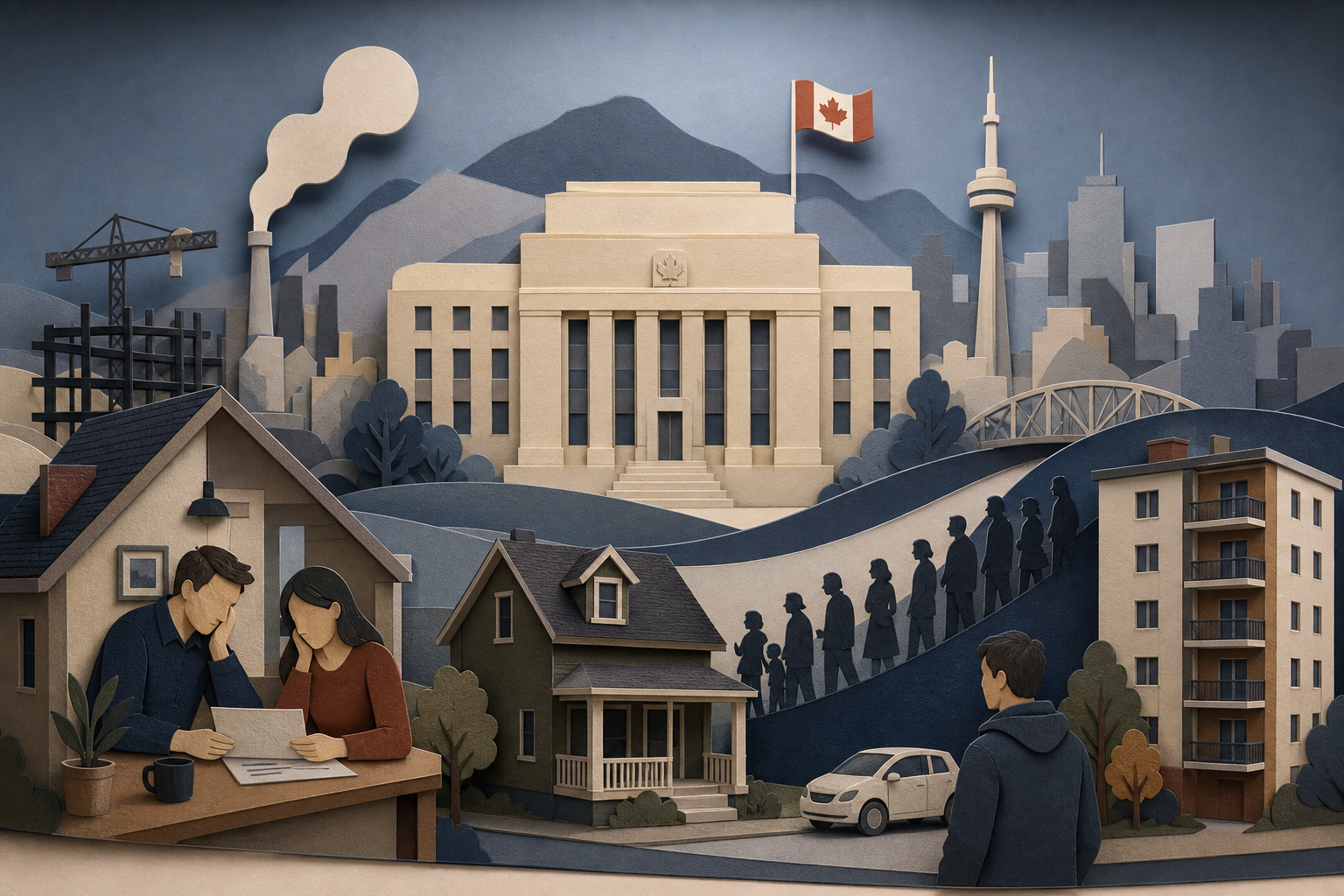
But the more structural constraint is happening in real time across the country. Roughly $250 billion to $300 billion in mortgages are resetting in 2026. Most of those were signed in 2021 or 2022, when five-year fixed rates sat below two percent. Those borrowers are now renewing at five or six percent.
This is effectively a rate hike that the Bank didn't need to announce. Even if the overnight rate stays at five percent for the rest of the year, the effective interest rate paid by Canadian households is rising every month. A family in Mississauga that locked in at 1.79 percent in March 2021 and is renewing this summer will see their monthly payment jump by $800 to $1,200, depending on the remaining principal. That's $800 per month that stops circulating in the economy.
Holding now means cutting later will cost more
The June hold shifts all attention to the July Monetary Policy Report. If second-quarter data continues to undershoot expectations, the Bank will face a choice: cut rates and risk re-igniting inflation, or hold rates and accept that the cumulative effect of the last two years of tightening is now pushing the economy toward contraction.
Central bank policy works with a lag. The common estimate is twelve to eighteen months. Weak Q1 2026 data is largely the result of rate hikes that took effect in 2024 and 2025. The Bank is looking backward at data that reflects decisions it made years ago, trying to predict what will happen eighteen months from now. By the time it has enough evidence to justify a cut with confidence, the economy may already be in a deeper slowdown than inflation risk would have justified.
There's also the currency problem. If the Bank of Canada cuts before the U.S. Federal Reserve, the Canadian dollar weakens. A weaker dollar makes imports more expensive, which pushes inflation back up through a different channel. The Bank can't move independently of the Fed without paying that price.
For borrowers, the takeaway is blunt: don't wait for relief this summer. The earliest plausible cut is fall, and even that assumes data deteriorates faster than the Bank expects. More likely, rates stay elevated into 2027, and when cuts finally come, they'll be smaller and slower than the hikes were.
The mortgage reset cliff is doing the Bank's work for it. The question is whether it's doing too much.