Europe's Plan to Stockpile Critical Minerals Isn't the Solution It Thinks It Is

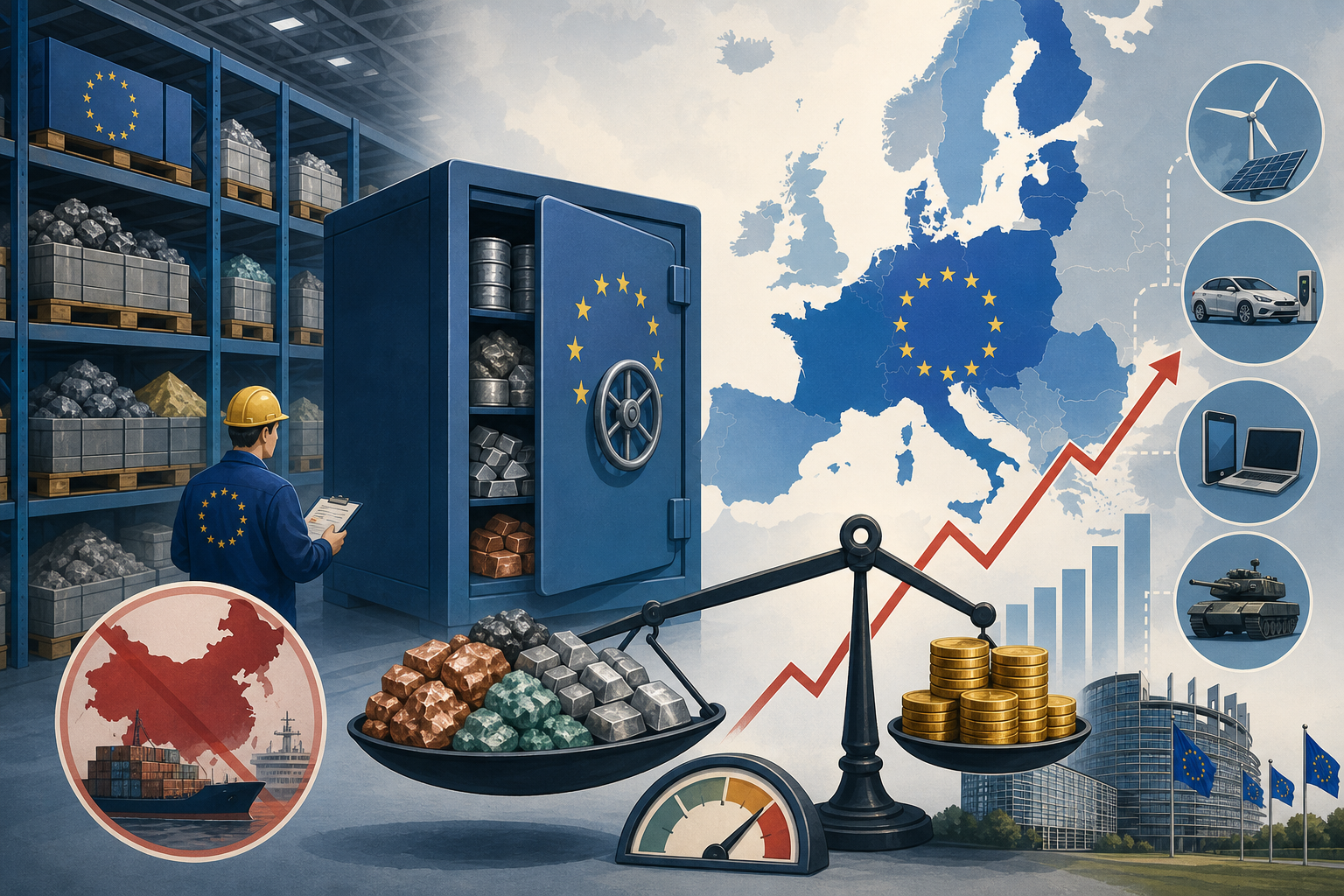
The European Union wants to decouple from Chinese mineral supply. Beijing controls over 80% of the global supply chain for rare earths and refined lithium. That's a problem when you're trying to build battery factories and wind turbines at scale. So the EU Critical Raw Materials Act mandates extracting 10% and processing 40% of the bloc's annual mineral consumption domestically by 2030. Canada's in on it too—British Columbia alone has positioned itself as a primary alternative supplier through its Critical Minerals Strategy, backed by $7.4 billion in federal funding. The EIT RawMaterials, an EU-backed agency, just issued a warning: stockpiling critical minerals as a security buffer involves high fiscal risk and market distortion. They're right, but not for the reasons most people think. The obvious problem is cost. Governments would be sitting on inventories of minerals that might never get used, or worse, become obsolete before they're needed. Cobalt was the hot material five years ago. Now lithium-iron-phosphate batteries are eating its market share, and solid-state chemistries might phase it out entirely. Stockpile cobalt today and you're left holding a strategic reserve of yesterday's technology. But the real issue is structural. A stockpile doesn't solve the underlying problem, which is that Western mines can't compete with Chinese production on price. Beijing can flood the market whenever a new North American or European project comes online, dropping prices below the breakeven point and rendering the project "unbankable." It's happened repeatedly. Molycorp, the largest rare earth mine outside China, went bankrupt in 2015 after Chinese producers undercut its pricing. MP Materials, which bought the assets, only survived because the US Defense Department became a guaranteed customer. This is why the EIT's second recommendation matters more than the first. They're calling for price floors—guaranteed minimum prices that governments would pay to keep domestic miners solvent during downturns. Not a stockpile of the commodity itself, but a commitment to act as buyer of last resort. That changes the math for private investment. If you're a pension fund or a private equity firm, you won't bankroll a rare earth project in northern BC when a competitor with state backing can sell at a loss to kill your returns. But if the Canadian or EU government guarantees a floor price, suddenly the project has a downside hedge. The problem with price floors is that they're expensive and they look like exactly what they are: industrial policy dressed up as security strategy. Which is fine, if you're willing to call it that. The EU and Canada are trying to treat critical minerals as both a market commodity and a defense asset. Those are incompatible frameworks. Defense assets don't have to be profitable. Commodities do. Pretending you can have both without fiscal commitment is what creates the half-measures: a stockpile that doesn't protect supply, a regulatory framework that doesn't reduce permitting timelines, a strategy document that doesn't actually derisk investment. There's one other thing the EIT is right about. The lack of transparent, standardized price benchmarks for rare earth oxides makes the whole market look like a private deal instead of a tradable commodity. Copper has the London Metal Exchange. Lithium carbonate has spot indexes now. Dysprosium and terbium? You're negotiating in the dark. Until there's a public pricing mechanism, institutional capital won't touch it at scale, and without institutional capital, the 40%-domestic-processing target is a wish. Stockpiling is the easy answer. It lets governments say they're doing something without committing to the hard part, which is making domestic production economically viable against a competitor who doesn't separate security from subsidy. The minerals are in the ground. The demand is real. What's missing is the willingness to structure the market so that extracting them in high-regulation jurisdictions doesn't require heroic optimism from investors.