China's Steel Demand Didn't Collapse, It Redistributed to Manufacturing and Exports

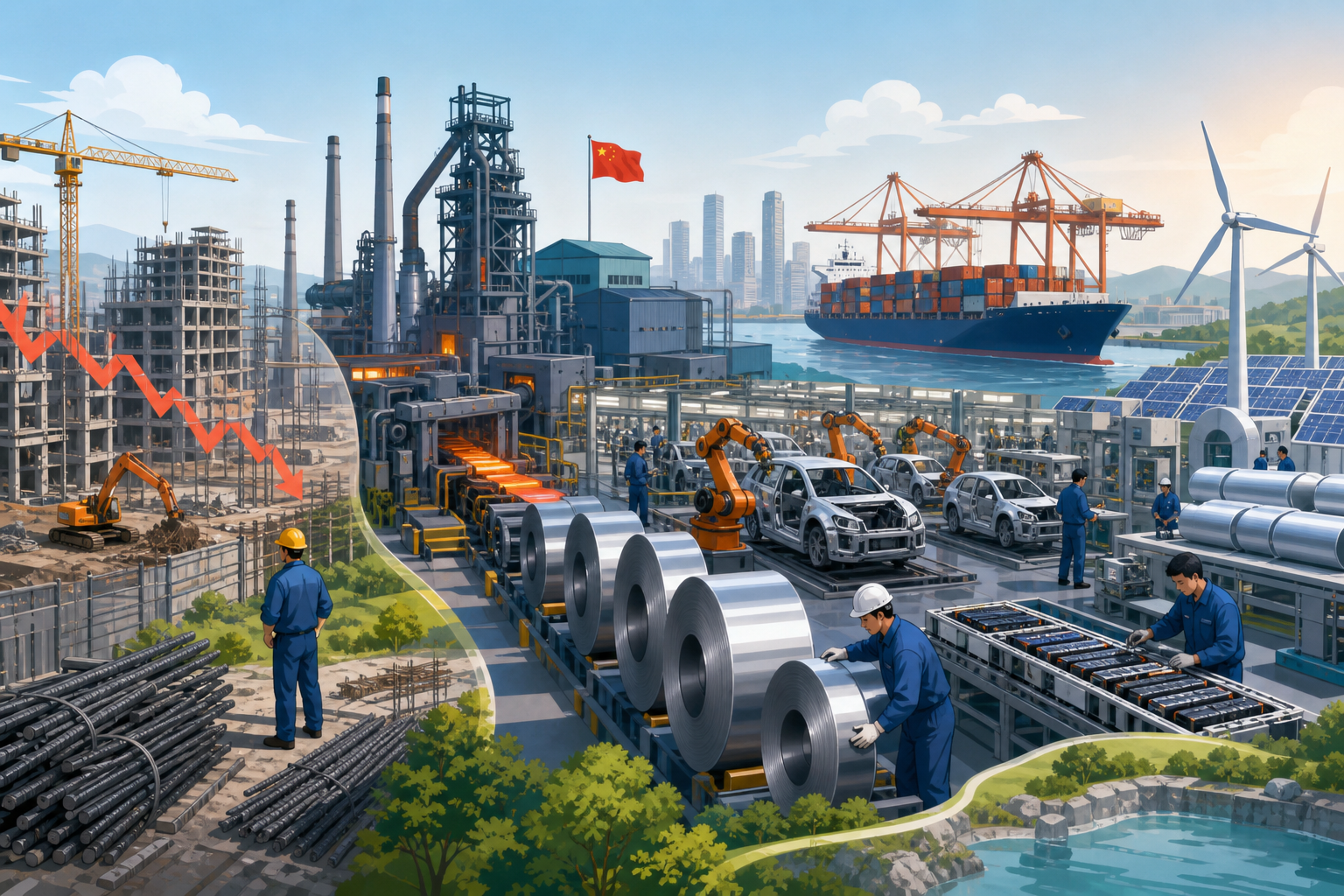
A lithium battery plant in Jiangsu province consumed 12,000 tons of specialized cold-rolled steel last quarter, more than twice what the facility ordered in the same period two years ago. That's not an outlier. Across China's manufacturing belt, orders for high-grade steel products are climbing even as rebar demand from construction sits 30% below its 2020 peak. The total tonnage isn't collapsing. It's moving.
For two decades, China's steel cycle tracked the property market with near-perfect correlation. Developers bought concrete, contractors bought rebar, and the blast furnaces ran at capacity. That engine broke in 2021 when the liquidity crisis hit and hasn't restarted. Property investment has fallen for 38 consecutive months. New project starts are down by half. The assumption was that steel demand would follow the same trajectory, sharp, sustained decline. It didn't.
What happened instead was absorption. The volume that disappeared from construction showed up in two places: manufacturing and overseas shipments. Neither fully replaces what was lost, but together they've turned what looked like a demand cliff into something closer to a long, managed plateau.
Manufacturing Picks Up What Property Dropped
The shift is visible in product mix. Hot-rolled coil and specialized alloys, used in electric vehicle frames, battery casings, and solar panel mounts, are seeing order growth in the mid-teens year-over-year. Rebar and wire rod, the workhorses of residential construction, are down by a third over the same window. The China Iron and Steel Association reports that the "New Three" sectors (EVs, lithium batteries, solar products) now account for roughly 18% of total steel consumption, up from under 10% in 2019.
This matters because the steel these sectors use is different. Manufacturing needs thinner, stronger, more precisely alloyed products. Margins on these grades run 15-20% higher than commodity construction steel, which has kept some mills profitable even as overall volumes stagnate. The catch is scale. A single 40-story residential tower consumes more steel than 10,000 electric sedans. Manufacturing growth cushions the fall but doesn't replace the mass.
Exports Become the Pressure Valve
Chinese steel exports hit 96 million tons in 2024, the highest level since 2016 and up 34% from the prior year. Mills are offloading surplus capacity into global markets at prices that foreign competitors can't match. The average export price for hot-rolled coil in late 2024 was roughly $485 per ton FOB, compared to $620 for comparable European production.
This strategy has limits. The EU, Southeast Asian nations, and North American jurisdictions have all launched anti-dumping investigations or raised tariffs in the past 18 months. The European Commission's Carbon Border Adjustment Mechanism, effective 2026, will add an estimated $50-80 per ton to Chinese steel entering the bloc. As these barriers multiply, the export valve narrows.
What the Plateau Actually Means
The current equilibrium is not stable, but it is durable. Government directives emphasize production discipline, CISA's repeated calls for mills to limit output, limit inventory, and limit costs are being enforced through informal coordination among the largest state-owned producers. Smaller private mills are being squeezed out through consolidation.
Demand isn't rebounding. It's reorganizing. The question is whether manufacturing and constrained exports can hold the plateau long enough for the industry to right-size without mass closures. So far, the answer is yes, but only because the government is managing the descent with the same precision it once managed the climb.