Canada Eyes 160-Jet Mixed Fleet: 88 F-35s Plus 72 Gripens in $40-Billion Gamble

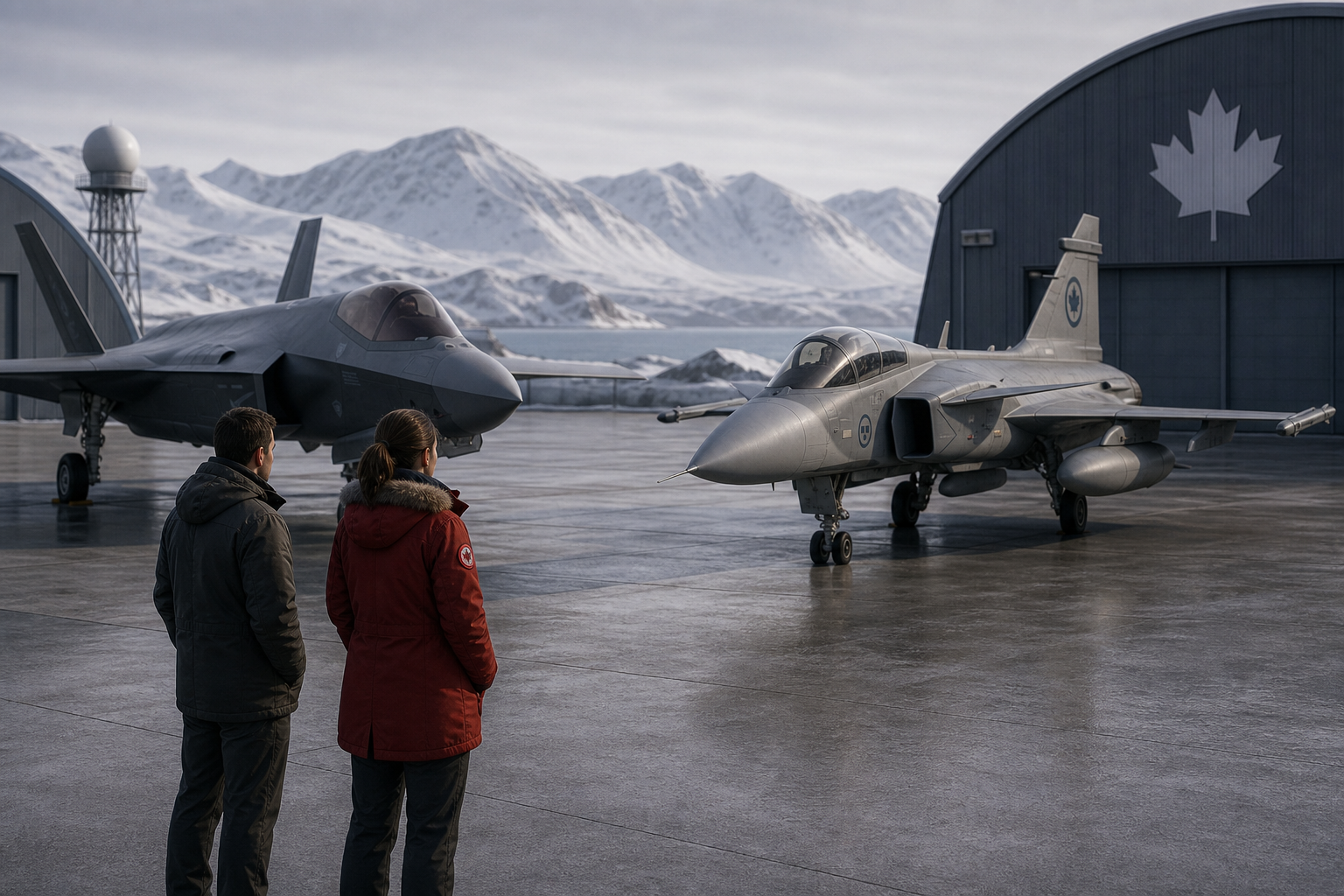
Canada Eyes 160-Jet Mixed Fleet: 88 F-35s Plus 72 Gripens in $40-Billion Gamble
The math doesn't add up until you realize what Ottawa is actually buying.
Canada formally committed to 88 Lockheed Martin F-35 Lightning II fighters in 2023, priced at roughly $19 billion. That was supposed to be the end of the fighter replacement story. It isn't. High-level discussions inside the Department of National Defence now include a second procurement: 72 Saab Gripen E aircraft to supplement the F-35 fleet. The combined force would exceed 160 jets, more than double the 65 CF-18 Hornets the program was originally designed to replace.
The sticker shock runs to at least $40 billion in acquisition costs alone, before counting decades of operational expenses. For a government under pressure to hit NATO's 2% GDP spending target while managing a structural deficit, this looks insane. Unless you understand what's actually being purchased.
The Industrial Politics of a 9,000-Job Project
The Gripen deal is being pitched as the largest industrial project in Canadian history. Saab has reportedly committed to Industrial and Technological Benefits worth 100% of the contract value, which in aerospace procurement terms means domestic manufacturing, technology transfer, and final assembly in Canada. Early projections suggest up to 9,000 jobs, most of them in Quebec and Ontario where aerospace manufacturing clusters already exist.
This is the real product. The jets are the delivery mechanism.
Lockheed Martin's F-35 ITB package, while substantial, involves component work and software integration spread across multiple sites. Saab's offer puts airframe assembly and major systems production on Canadian soil. For a government that needs to be seen spending defence dollars at home, not in Fort Worth, the Gripen is a political hedge dressed as capability diversification.
The 72-unit order would make Canada Saab's largest Gripen customer outside Sweden. That scale matters for pricing, for maintenance infrastructure, and for the credibility of the platform in export markets where Sweden is competing with American and French alternatives.
Arctic Runways vs. Fifth-Generation Warfare
The operational rationale hinges on role separation. The F-35 is a first-strike, high-intensity platform built for contested airspace where stealth matters. It is also maintenance-intensive, requiring climate-controlled hangars and advanced diagnostics for its sensor fusion and low-observable coatings.
The Gripen E is designed for austere conditions. Saab markets it as capable of highway landings and rapid turnaround on unprepared surfaces, exactly the profile Canada's Arctic bases represent. CFB Inuvik, CFB Yellowknife, and forward operating locations in Nunavut do not have the infrastructure to support F-35 operations at scale. The Gripen could.
This is the "high-low mix" doctrine the U.S. has used since the 1970s, when F-15 Eagles paired with cheaper F-16 Fighting Falcons. A small number of expensive, exquisite platforms handle the hard targets. A larger number of workhorses handle air policing, sovereignty patrols, and presence missions where stealth is irrelevant.
Canada's actual threat matrix supports this. Arctic sovereignty missions involve intercepts of long-range Russian bombers, not penetrating layered air defenses. NORAD commitments require jets in the air, not jets optimized for strike. The CF-18 spent four decades doing exactly this kind of work.
The Logistics Trap
Where the plan falls apart is sustainment. Operating two distinct fleets means two training pipelines, two sets of spare parts, two maintenance certifications, two software upgrade cycles. The Royal Canadian Air Force is already understaffed. Doubling the logistical burden without doubling personnel is a bet that contractor support and modular maintenance can cover the gap.
It can't, historically. Mixed fleets work when one type operates in low tempo and the other in high tempo, allowing resource pooling. If both are flying sovereignty missions concurrently, the advantage collapses. You end up with twice the overhead and half the readiness.
The interoperability question is quieter but sharper. The F-35's sensor fusion is designed around a network of F-35s sharing data in real time. Inserting non-stealthy Gripens into that picture during joint operations complicates the tactical picture, especially in scenarios where the U.S. is leading the mission architecture.
Where the Bet Pays Off
If savings rates stay high and workflow stays stable. Wrong metaphor. If Saab delivers the ITB jobs, if the Gripen proves reliable in Canadian winters, if the RCAF can staff two fleets without cannibalizing readiness, then Canada gets sovereignty coverage in the North and expeditionary capability in the South without waiting until 2035 for the full F-35 order to deliver.
The alternative is an 88-jet F-35 fleet spread too thin to cover both mission sets, with no industrial offset large enough to justify the political cost of buying American.
At $40 billion, this isn't a procurement decision. It's a 30-year industrial policy with wings.