Why Canada Just Bought a Dozen Italian Combat Trainers for $350 Million

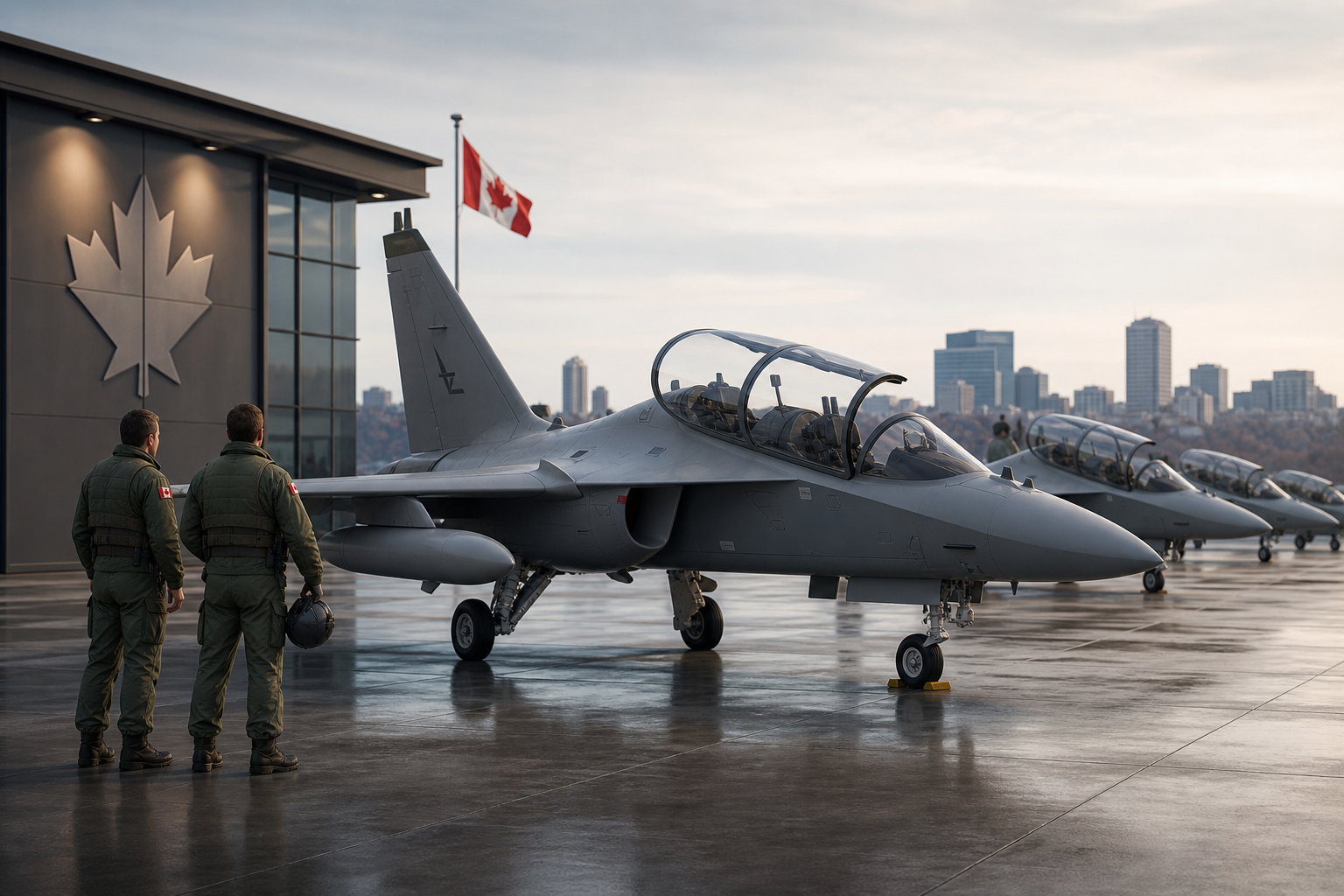
The International Test Pilot School in London, Ontario, just signed a contract for up to twelve M-346 Master jets from Leonardo S.p.A. The estimated value sits north of US$350 million. That's not a government purchase. ITPS is a private company, and this fleet will train foreign military pilots under contract—a business model that barely existed a decade ago.
The M-346 is a twin-engine transonic trainer built specifically to prepare pilots for aircraft like the F-35. It can sustain 8g maneuvers and its cockpit can be reconfigured to mimic the avionics suite of various frontline fighters. The plane itself is half the point. The other half is the Embedded Tactical Training System, which overlays synthetic threats and targets onto the pilot's displays during flight. A student can dogfight an enemy that doesn't exist, see a surface-to-air missile launch from a position where there's only empty sky, and practice responses to scenarios that would cost millions to stage with real aircraft and live ordnance.
This purchase makes ITPS Canada one of the largest private operators of advanced jet trainers globally, and it reflects a broader shift in how nations handle the bottleneck in their pilot pipelines.
The Capacity Problem
NATO air forces are running 10 to 20 percent below target pilot rosters, a gap that widened through the mid-2020s as geopolitical tensions in Europe and the Indo-Pacific escalated demand. Training a fighter pilot from zero to combat-ready takes three to five years and costs several million dollars. The constraint isn't classroom time—it's flight hours on complex aircraft, and instructor availability.
State-run training systems are bureaucratic and capital-intensive. Canada's own CF-18 replacement with the F-35 has created urgency around producing pilots qualified to fly a fifth-generation platform, but standing up new government training capacity takes years. Maintenance on aging trainer fleets eats budget. Instructor pipelines are thin because experienced pilots often leave for higher-paying airline jobs.
Private contractors like ITPS can move faster. They operate outside procurement cycles, purchase aircraft directly from manufacturers, and sell training as a service to foreign governments. The customer gets qualified pilots without building infrastructure. ITPS gets a long-term revenue stream tied to geopolitical tailwinds that aren't going away.
Why the M-346 Wins the Economics
Flying an actual F-35 or CF-18 for training costs ten to twenty times more per hour than flying the M-346. The Italian jet burns less fuel, requires simpler maintenance, and doesn't subject an eight-figure airframe to unnecessary wear. But the critical advantage is the Live-Virtual-Constructive training architecture.
A single M-346 sortie can include live flight, ground-based simulators linked over a network, and computer-generated entities that simulate enemy aircraft or missile systems. Four pilots can train together—two airborne, two in sim—against a synthetic red force managed by instructors on the ground. The scenario complexity rivals what you'd get from live air combat exercises that require coordinating dozens of real aircraft, tankers, range space, and safety observers.
This isn't "get used to the jet" training. It's tactical mission rehearsal at a fraction of the cost. And for smaller air forces that can't afford to keep their frontline fighters constantly airborne for training, that cost delta matters.
London, Ontario as Defense Hub
ITPS has been in London since 2000, but this deal repositions the city within North America's aerospace corridor. A fleet of twelve Italian-made transonic jets requires localized supply chain support, maintenance expertise, and integration with Canadian airspace procedures. Leonardo is betting that relationship expands beyond this contract.
The revenue model depends on throughput. Twelve aircraft can generate thousands of flight hours annually if utilization stays high, and global demand for fifth-gen-qualified pilots is measurable in the hundreds per year across allied nations. ITPS now has the capacity to train pilots for countries that lack domestic advanced jet programs entirely—a market that includes most of NATO's smaller members and several Indo-Pacific partners building or upgrading their air forces.