Scientists Map 150-Kilometre Canyons and Century-Old Coral Forests Off Newfoundland Coast

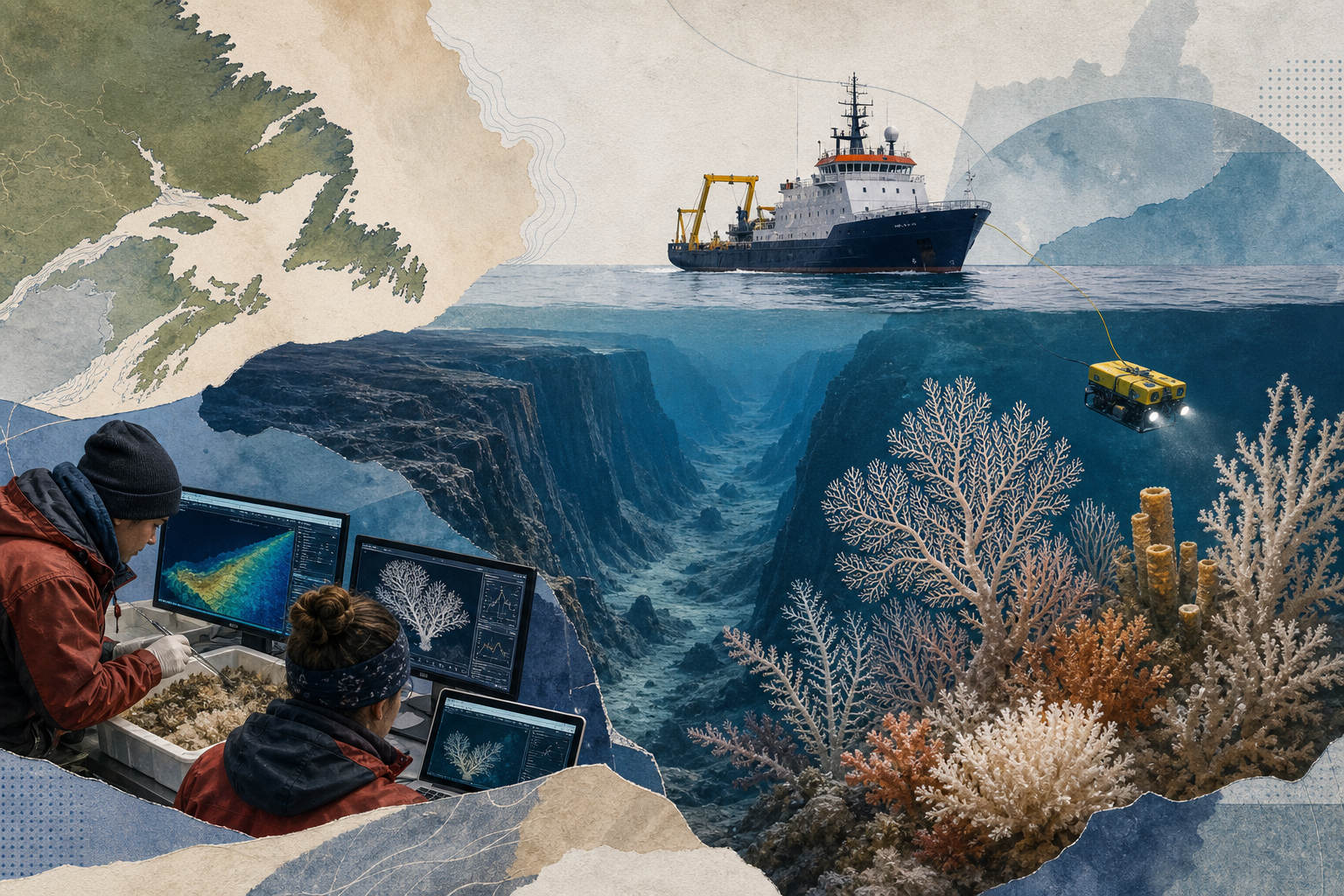
The stretch of ocean floor off Newfoundland and Labrador is less mapped than the surface of Mars. That changed in 2026 when researchers from Oceana Canada and Fisheries and Oceans Canada sent remotely operated vehicles into waters where sunlight stops reaching. What they filmed will reshape how Canada thinks about protecting its ocean territory. Submarine canyons running more than 150 kilometres. Coral colonies over 100 years old, growing in total darkness at depths where pressure would crush an unprotected human. Forests of sea pens and sponges acting as nurseries for the fish stocks that keep Atlantic Canada's fishing economy alive. The discovery was unveiled at a national ocean event in Ottawa in May, timed to land just ahead of World Oceans Day. The choice of venue matters. This isn't just a nature documentary moment. These canyons sit off the coast of a province whose economy depends on the offshore harvest, and the federal government has committed to protecting 30% of its marine territory by 2030. The findings give Ottawa something concrete to point to when it needs to justify closing areas to bottom-contact fishing. Cold-water corals don't work like the ones tourists snorkel over in the Caribbean. They don't photosynthesize. They grow in pitch black, capturing food from passing currents, adding a few millimeters per year. A coral over a century old has been sitting on that canyon wall since before the First World War, a biological time capsule from an era when industrial trawling didn't exist. That age is the economic argument, not just the conservation one. These ecosystems predate the modern fishing industry. Protect them and you're protecting the baseline, the original nursery that produces the biomass fishers depend on. Destroy them with a single pass of a bottom trawler and you've erased a century of slow accumulation. The regrowth timeline is longer than a career, longer than most companies' planning horizons. The canyons themselves function as conduits. They channel nutrient-rich water up from the deep, feeding phytoplankton blooms that support everything above. Off Newfoundland and Labrador, the cold Labrador Current collides with the warm Gulf Stream, creating a mixing zone. High nutrients. High biodiversity. The kind of place where protecting the ocean floor isn't abstract environmentalism—it's infrastructure maintenance for the fish stocks that generate millions in export revenue. But identifying a habitat and protecting it are different problems. These canyons sit hundreds of kilometres offshore. Monitoring them for illegal trawling requires ships, fuel, time, enforcement staff. The Department of Fisheries and Oceans has finite resources and coastal areas that also need attention. A "no-take" zone on a map is only as strong as the patrol schedule behind it. Even if Canada does enforce protections, these canyons face a threat no local policy can solve. Ocean acidification and warming don't stop at marine protected area boundaries. The corals adapted to a narrow temperature range over evolutionary time. The Atlantic is warming faster than the global average. A habitat can be shielded from trawlers and still collapse if the water chemistry shifts. The comparison Bay Street might understand: you can fireproof the building, but if the foundation is sinking, the fireproofing doesn't matter. Oceana Canada and Canadian Geographic made the reveal high-profile for a reason. Public attention translates to political pressure, and political pressure is what moves federal conservation targets from aspiration to implementation. The footage exists. The species are catalogued. The economic case for protection is there. What happens next depends on whether Ottawa treats this discovery as a prompt for action or just another dataset to file. The canyons have been there for millennia. The corals have been growing for over a century. The question is whether they'll still be there in 2050.