I Spent $356 on a Heated Jacket and It Taught Me What 'Gouging' Actually Means

I bought a heated jacket for $356 last month. Not because I needed it. Because I wanted to understand what happens when a piece of clothing crosses the line from "product" to "investment", and whether that line means anything at all.
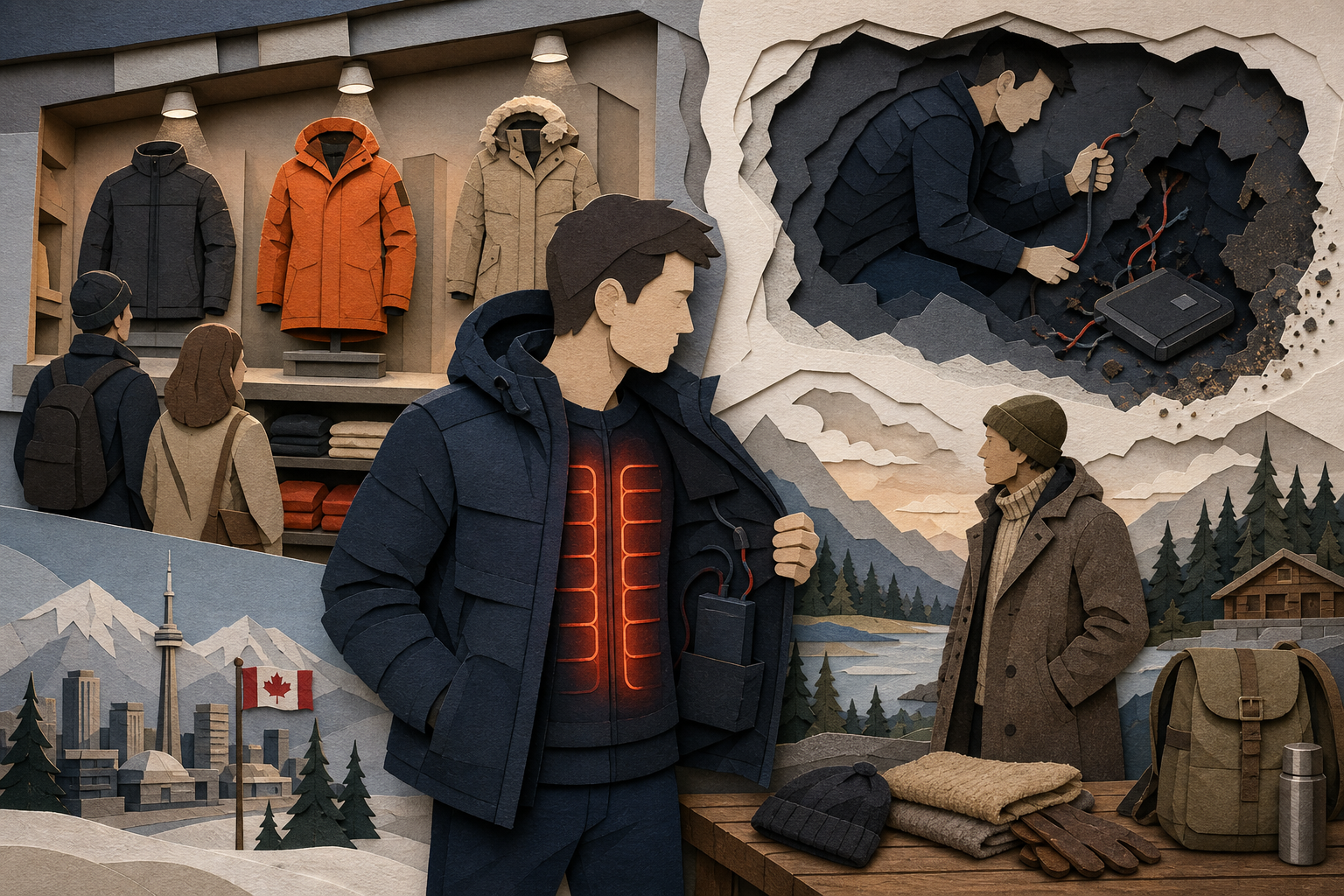
The jacket came from a Canadian brand that positioned itself somewhere between mass-market technical wear and the luxury outerwear tier where a parka can run $1,200. It had recycled polyester. Ethical down certification. A removable lithium-ion battery pack. Three heat settings. A lifetime warranty on the fabric. The heating elements, naturally, were covered for two years.
Two years. That number is the tell.
The thing that breaks first isn't the thing you're paying for
A traditional wool coat can last thirty years. A high-end down parka, if you treat it well, might give you fifteen. The $356 heated jacket I bought will last until the battery degrades or the wiring fails, which is roughly two to five years depending on how often you charge it and whether you remember to remove the battery pack before washing.
The fabric will outlive the function. You're paying for a piece of tech that happens to be sewn into a coat, not a coat that happens to have tech in it. That's the first reframe. Heated apparel isn't durable goods. It's disposable electronics with a very expensive fabric enclosure.
The brand's marketing leaned hard on sustainability. Recycled materials, carbon offsets, a take-back program for end-of-life garments. Fair. But a "sustainable" heated jacket is a contradiction at its core. The heating system can't be easily separated from the textile, which means the whole thing becomes e-waste the moment the electronics fail. Modularity would solve this, a heating system you can pull out entirely, leaving a recyclable shell, but modularity doesn't photograph as well.
I did the math on cost-per-wear. If I use the jacket 100 days a year for three years, that's $1.19 per wear. A $60 fast-fashion puffer that falls apart in one season works out to about $0.60 per wear if you use it heavily, but you're buying a new one every year and the total outlay over three years is $180. The $356 jacket wins on total cost, loses on upfront barrier. That barrier is what makes the "buy quality once" advice feel like smugness to someone who doesn't have $356 in discretionary cash in February.
Gouging is the wrong word for the wrong problem
The jacket isn't overpriced for what it is. It's accurately priced for a category that shouldn't exist in its current form. Heated gear started as specialized workwear, construction, mining, outdoor occupations where it solved a real problem. It has since been repackaged as urban lifestyle gear for people who mostly walk from their car to the office.
I wore it twice in situations where the heating function actually mattered. The rest of the time it was a $356 regular jacket I could have replaced with a $150 unheated parka and better layering. The value proposition only works if you use the thing it's expensive for, and most buyers won't.
The Competition Act has rules about drip pricing and fake discounts. It doesn't have rules about selling people solutions to problems they don't have. That's just called marketing.
The jacket works. It's warm. It'll last until the battery doesn't. And every time I wear it I'm reminded that "worth it" and "necessary" are two completely different calculations, and that the first one is a lot easier to justify when you're not worried about the second.