France Runs a Working Returnable-Packaging System. Canada's Pilot Collapsed. What Changed?

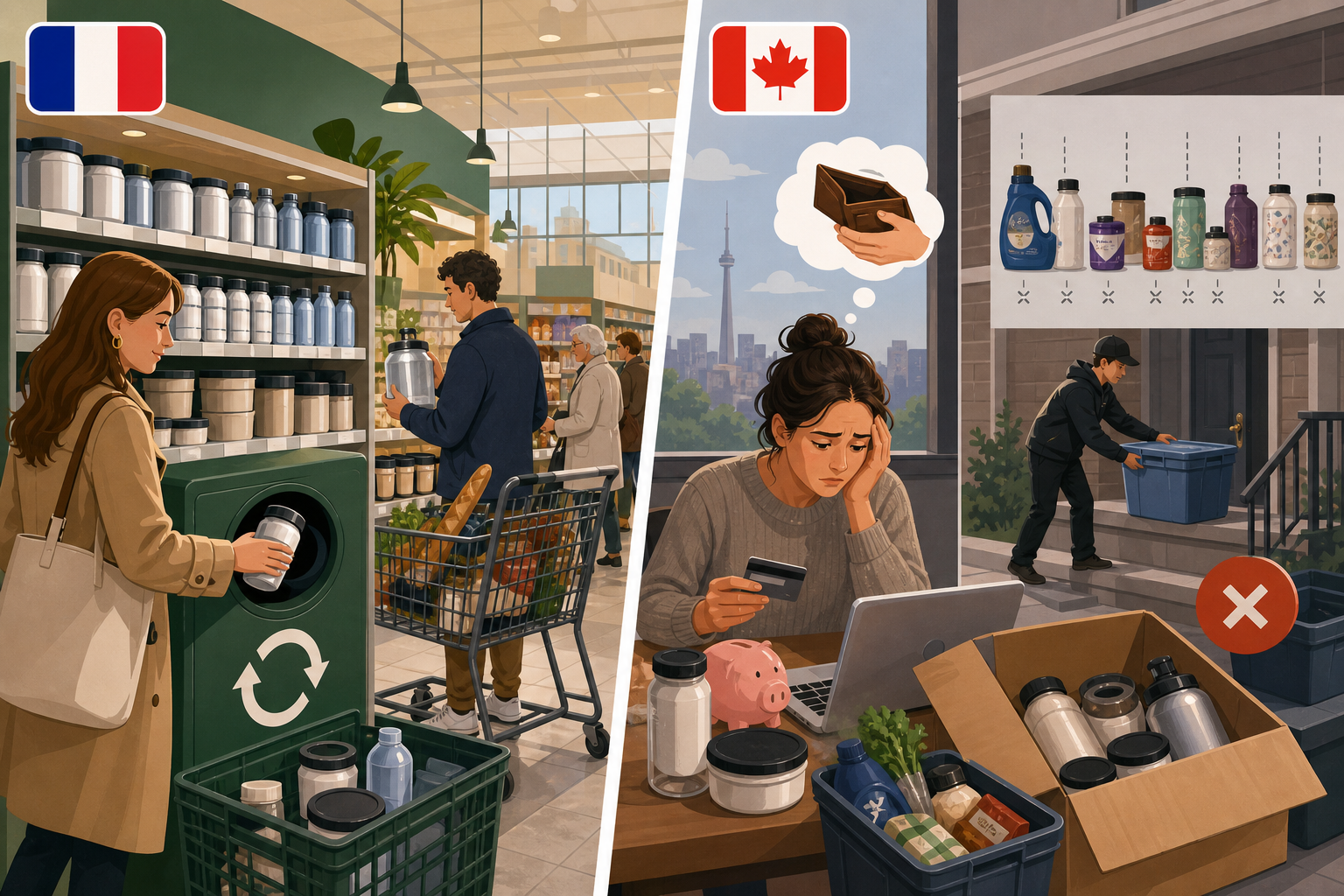
France figured out how to make reusable grocery packaging work at scale. In 2025, Loop—the TerraCycle-backed platform selling Tide, Propel, and Häagen-Dazs in returnable containers—operates in over 100 Carrefour stores across France, where shoppers drop off empties the same way they drop off wine bottles. The model works. Meanwhile, the Canadian pilot with Loblaw launched in Ontario in 2021 and shut down two years later. Same containers. Same idea. Different outcome.
The difference wasn't consumer appetite. Both countries poll identically on plastic waste concern. Canadians say they want alternatives. The federal government's 2024 Pollution Prevention Planning Notice for Primary Food Plastic Packaging is pushing grocers toward reuse. Plastic packaging generates roughly half of Canada's total plastic waste, according to Environment and Climate Change Canada, so the regulatory pressure is real. The problem was logistics.
The friction layer
Loop's Canadian pilot ran through PC Express, Loblaw's delivery service. You ordered groceries online, received them in stainless steel or glass containers with a $2-to-$5 deposit per item, and scheduled a return when you were done. That sounds fine until you map it onto a household that's also trying to coordinate daycare pickups and manage a grocery bill that's up roughly $3,000 a year since 2021. The deposit isn't the issue—you get it back. The issue is the extra step. Returns required a separate transaction, either a scheduled pickup or a drop-off at a PC Express hub, which in practice meant adding "return Loop containers" to a mental checklist that was already overloaded.
In France, the system integrated directly into the shopping trip. Walk into a Carrefour. Buy the product. When you're done, drop the empty container into a return bin on your next trip, the same way you'd return a shopping cart. No scheduling. No separate logistics layer. The cognitive load dropped to near-zero, and participation rates followed. That's the headline difference: France embedded the return into an existing routine. Canada tried to create a parallel one.
The infrastructure gap
The other half of the problem was back-end. Reusable packaging only works if you can clean and refill containers faster and cheaper than you can make new ones. That requires industrial wash facilities with high-temperature sanitization, sorting systems, and tight reverse-logistics loops. France already had this. Europe built out centralized cleaning infrastructure for deposit-return bottle schemes decades ago, and Loop piggybacked on it. Canada didn't.
Ontario lacked the wash-hub density to make the economics competitive. Loblaw would have needed to either build dedicated facilities or partner with third-party operations that didn't exist at the required scale. Without that, the cost per wash per container stayed too high. Meanwhile, the carbon math started working against them: if a heavy glass jar only circulates three or four times before it's lost or broken, the energy used to manufacture and clean it can exceed the footprint of a thin single-use plastic container. Reuse is only sustainable when the container circulates enough times to amortize the upfront impact. That requires volume and density, which the pilot never reached.
Geography doesn't help. France's population density makes reverse logistics cheaper. Transporting empty containers across Ontario's sprawl burns fuel and adds handling cost. The French model works partly because the distance between consumer, store, wash hub, and refill point is short. Canada's version would need a fundamentally different structure—probably regional wash facilities, probably anchored around population centers, definitely not reliant on home delivery.
What a second attempt requires
Loop is still interested in Canada, but the next version can't look like the first. If it comes back, expect in-store pilots first. Expect partnerships with municipalities that already run deposit-return programs. Expect standardized containers across brands, which solves the wash-hub problem but forces brands to give up custom packaging. And expect slower expansion. The French rollout took years. The Canadian pilot tried to scale too fast without the infrastructure to support it.
The gap isn't consumer willingness. It's logistics and density. France built the plumbing first. Canada didn't.