Canada Picks Sweden Over Boeing for Its Next Surveillance Fleet
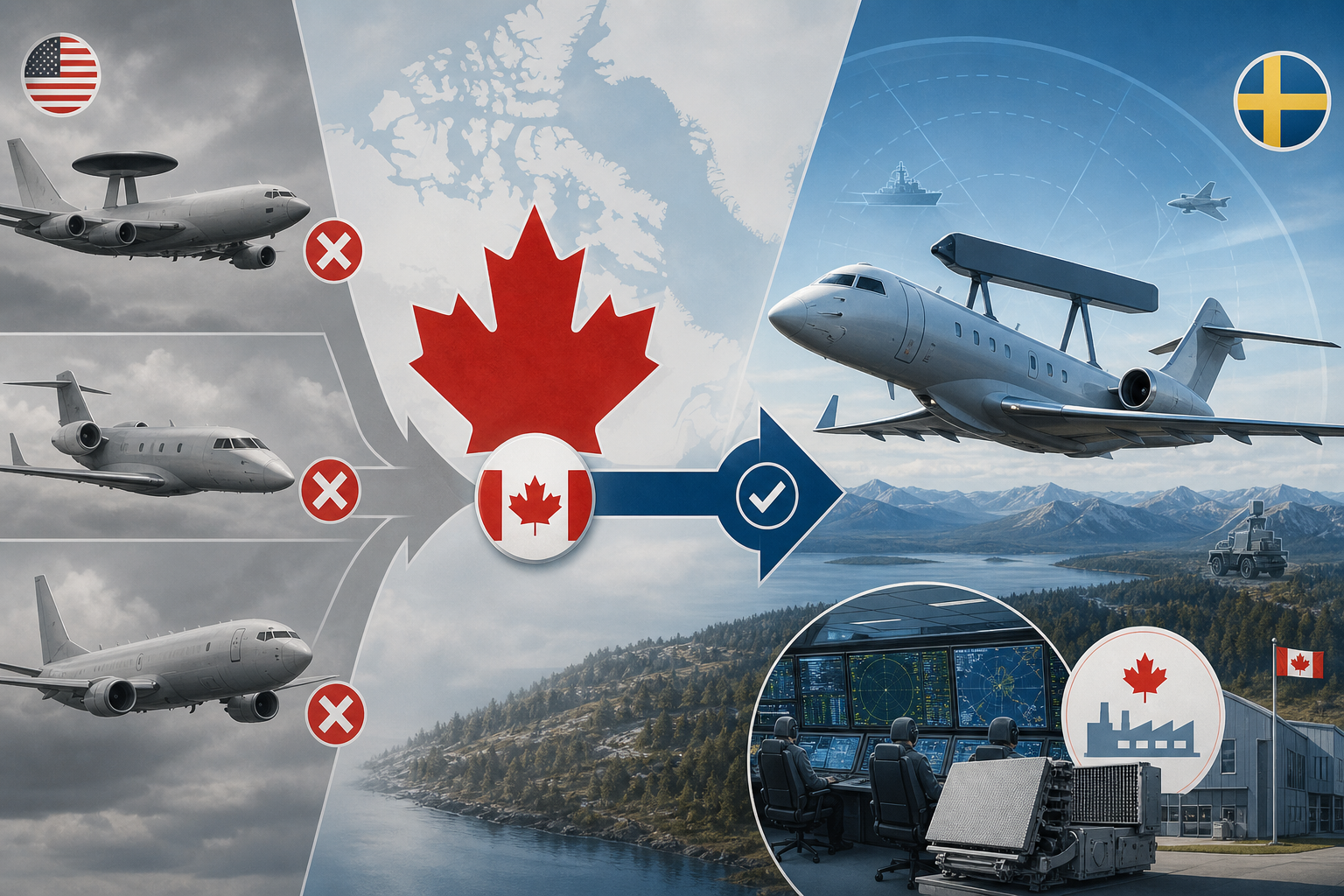
Canada just walked past Boeing and picked a Swedish radar platform built on a Montreal business jet. The federal government announced it would acquire Saab's GlobalEye system to replace the aging CP-140 Aurora fleet, choosing extended-range surveillance over the American-made Boeing E-7 Wedgetail that most NATO allies have adopted. The decision centers on a modified Bombardier Global 6500—assembled in Canada—fitted with Sweden's Erieye ER radar. That radar tracks targets across 550 kilometres in air, on water, and over land simultaneously. Boeing's E-7 uses a 737 airframe. It's proven. It's standardized across the Five Eyes. Canada said no. The calculus wasn't just capability. Under Canada's Industrial and Technological Benefits policy, Saab must reinvest 100% of the contract value into the domestic economy. Bombardier gets the airframe work. That matters in Montreal, where aerospace employment has contracted since the C Series program transferred to Airbus. The political optics of handing a multi-billion-dollar surveillance contract to Boeing while a Canadian airframer sat available were poor. The technical case had to support it, and it did. The Global 6500 operates at 51,000 feet with an endurance exceeding 11 hours depending on fuel load and mission profile. It reaches Mach 0.90, faster than the E-7's cruise speed. More critically for Canadian geography, it can use shorter runways than a 737 variant. The Northwest Territories, Yukon, and coastal stations in British Columbia have infrastructure built for smaller aircraft, not commercial twins. A surveillance platform that requires a 9,000-foot runway limits where you can stage it. One that lands on 6,000 feet does not. Arctic sovereignty drove part of the requirement. Russian and Chinese activity in the Northwest Passage has increased as ice recedes. Fixed ground radar covers very little of Canada's northern approaches—the country is too large and too empty. Airborne surveillance fills gaps where permanent installations make no sense. The CP-140 Aurora, introduced in the 1980s, handled maritime patrol competently but wasn't designed for multi-domain coordination. The GlobalEye integrates directly with the RCAF's incoming F-35 fleet, feeding real-time tracking to fighters without requiring ground relay. In contested airspace, that cuts decision time. Critics of the Saab choice focus on interoperability. The U.S. Air Force, Royal Air Force, and Royal Australian Air Force all operate or are acquiring the E-7. Data formats, maintenance protocols, and joint mission planning are standardized around Boeing's architecture. Canada will now operate a unique configuration within the alliance—Swedish sensors, Canadian airframe, NATO integration requirements. That introduces training costs, parts logistics, and software integration work that wouldn't exist with an off-the-shelf American system. Those costs are real. But the sovereignty argument cuts the other way. Relying entirely on American defense contractors for critical surveillance infrastructure creates dependency. Sweden's defense industry operates independently of Washington's foreign policy priorities. A Canadian-assembled airframe means domestic control over major upgrades and serviceability timelines. If the U.S. imposes export restrictions on components during a future trade dispute, the RCAF still has options. The first aircraft won't reach Initial Operating Capability for several years—defense procurement in Canada moves slowly even after selection. The CP-140 fleet will retire before full replacement coverage exists. That's a known gap the Department of National Defence accepted when it finalized the timeline. What matters now is whether the industrial offsets deliver. Saab committed to investing contract value back into Canada. If that produces aerospace jobs in Quebec and supply chain work in Ontario, the decision gets easier to defend. If it becomes another paper commitment that never materializes, the interoperability critics will have been right.