Buy Your Retirement Property a Decade Early: The Reverse Mortgage Bridge Strategy

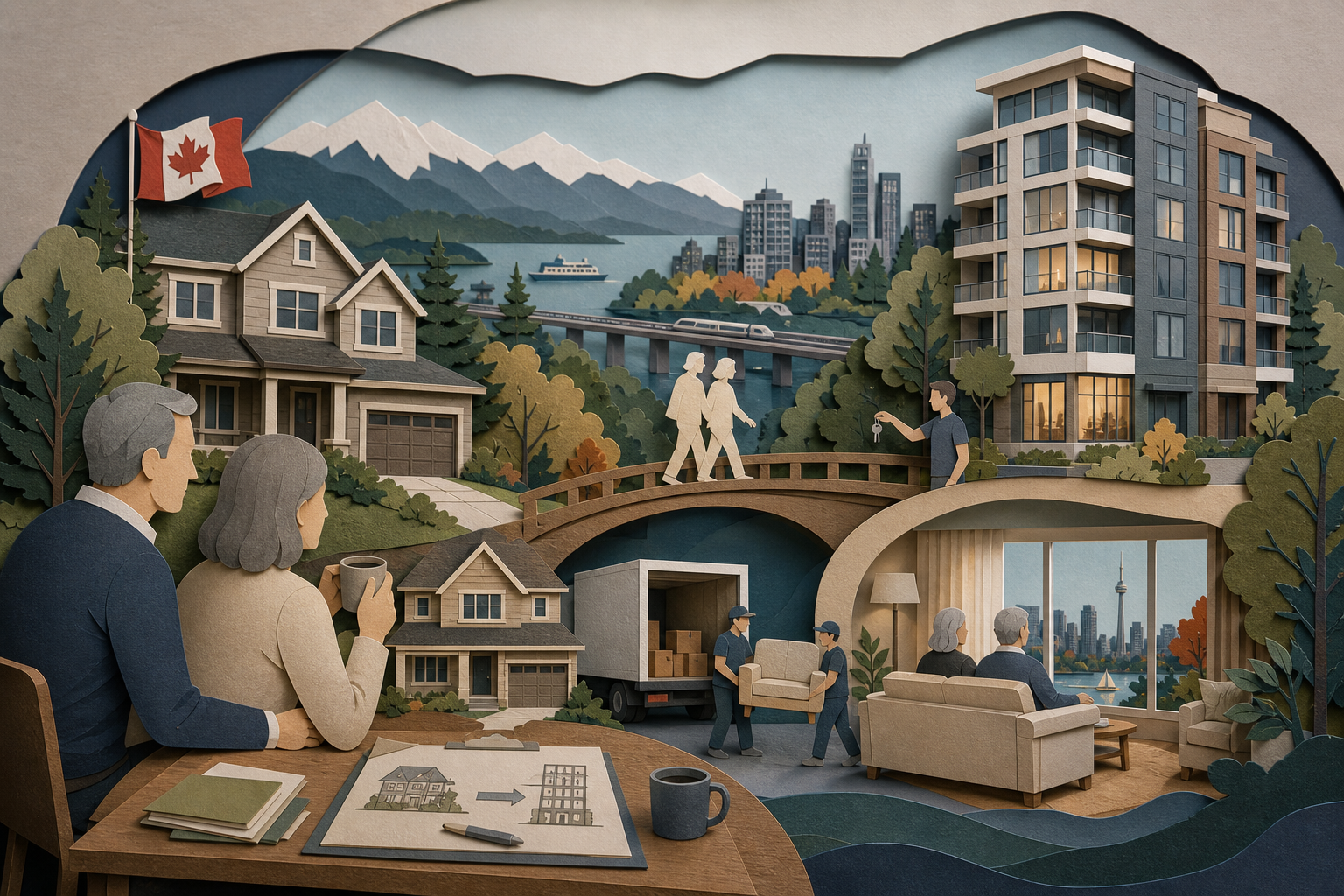
At 62, most Canadian homeowners sit on roughly $800,000 in equity and wonder when downsizing stops being a plan and becomes an emergency. The standard answer is "wait until you need to move," which guarantees selling under pressure while competing for the same small condo everyone else wants.
A reverse mortgage lets you flip that sequence. Instead of downsizing when life forces your hand, you buy the smaller property now, rent it out, and let both properties appreciate while you collect rental income with no debt service on the second purchase.
How the mechanics works
A reverse mortgage on your primary residence, say, a detached home in Vaughan or Burnaby, unlocks up to 55% of its appraised value without triggering monthly payments or income verification. If the home appraises at $950,000 and you're 60, you might access $425,000 tax-free. That cash becomes the down payment, or in some cases the full purchase price, on a two-bedroom condo in the same city.
The condo generates rental income immediately. Let's say $2,400 per month. The reverse mortgage on the detached home requires no payment; interest compounds, but the loan isn't due until you move out permanently or sell. Meanwhile, you're living in the detached home as always, and the condo pays for its own property taxes, maintenance fees, and a reserve fund.
"Most of my clients who execute this are trying to solve the 'double-move problem,'" says Test invite Partner1, Financial Planner. "They don't want to pack twice, live with family for six months between transactions, or accept the first lowball offer because their closing date is fixed and they've already bought the next place."
The ten-year runway matters. Both properties appreciate, likely in the 3-5% annual range if historical Canadian real estate patterns hold. By age 70, the condo you bought for $550,000 is worth closer to $720,000, and the detached home has similarly increased in value. More importantly, you've locked in today's price for your future residence, insulating yourself from a decade of price growth you'd otherwise pay as a buyer.
What happens at the transition point
At 70, or whenever you're ready, you move into the condo. The detached home can be sold immediately, which clears the reverse mortgage balance and unlocks a potentially massive capital gain, tax-free under Canada's principal residence exemption. The surplus can fund a TFSA, pay down the condo if you took a mortgage on it, or flow to heirs.
Alternatively, you convert the detached home into a rental property. A house rents for significantly more than a condo, often $3,500, $4,200 in the same markets where the condo rented for $2,400. That income, minus the reverse mortgage interest accrual, still generates positive cash flow and builds a second income stream for late retirement.
A third option: transfer the reverse mortgage to the condo and sell the detached home. HomeEquity Bank's CHIP product allows this if the condo qualifies and remains your principal residence. The sale proceeds, $600,000, $900,000, sometimes more depending on market and location, become liquid capital you control.
The cost structure and trade-offs
Reverse mortgage rates in 2026 sit roughly 2-3 percentage points above conventional five-year fixed rates. On a $400,000 advance, interest compounds to around $720,000 over ten years at 6.5%, assuming no voluntary payments. That's real money, but it's compared against a rental income stream of $28,800 per year and the appreciation on two properties instead of one.
Setup costs, appraisal, legal fees, and origination, run $3,000, $5,000. Property management on the rental condo, if you hire it out, takes 8-10% of monthly rent. These aren't trivial, but they're predictable and can be modeled in advance, which matters more than the absolute dollar figures when you're planning a decade out.
The strategy assumes stable health, a tolerance for being a landlord (or paying someone to do it), and a housing market that doesn't collapse. It also assumes you're confident you'll want to downsize. If you're unsure, buying the second property is just leverage with extra steps.
But for the homeowner who knows the detached house will eventually be too much, too many stairs, too much yard, too much space after the kids leave, this removes the crisis from the decision. You're not downsizing because you have to. You already did.